Israel Folau sacked for quoting the Bible - the very Bible you swear on
in
Court. Big business is Big Brother
Newsletter published on May 4, 2019
This newsletter is at http://mailstar.net/Folau-Big-Brother.doc
(1)
Israel Folau vs Big Brother. Folau’s religious freedom the defining
issue of
our time
(2) Pacific Islands Rugby Players (1/3 of Australia's team) unite
behind
Israel Folau
(3) Folau hearing: Any car that arrived or exited was
swamped
(4) Rugby Australia faces financial ruin over Israel Folau
case
(5) 'Rugby Australia failed to get Folau to sign off on the social media
clause in his playing contract'
(1) Israel Folau vs Big Brother.
Folau’s religious freedom the defining
issue of our time
https://www.theaustralian.com.au/sport/rugby-union/israel-folaus-religious-freedom-the-defining-issue-of-our-time/news-story/675b60e44832bf62246208ebd33d6eec
Israel
Folau’s religious freedom the defining issue of our time
ALAN
JONES
12:00AM MAY 3, 2019
Just when you thought the administration
of rugby could not get worse,
it continues to be a sporting
embarrassment.
Does no one in a position of leadership understand the
damage that is
being done to the game as a result of the Israel Folau
affair?
Who is going to be brave enough to put their hand up, even on the
eve of
this "tribunal" meeting tomorrow; or do we just keep digging the hole
and burying the game?
Let me say up front that Rugby Australia, the
administration, can’t win.
They have the most expensive legal advisers
that money can buy. Surely
they are telling Rugby Australia that this is
unwinnable.
RA may get some vicarious satisfaction by hoping that Israel
will be
punished, rubbed out of the game, humiliated, ostracised, denigrated
and
the contract ripped up.
Well, I say, do your best. That strategy
will not win.
I have written three articles in this newspaper on this
matter. They
have been among the most read and thousands of readers have
left comments.
It is unprecedented and 95 per cent of them support Israel
Folau’s right
to articulate his religious beliefs.
In one week it is
infinitely worse than it was.
We read in this paper, earlier this week,
that the gifted Polynesian
captain of Queensland rugby, Samu Kerevi, posted
on Instagram on Easter
Thursday, "God so loved the world that he gave his
only begotten Son
that, whosoever believeth in him should not perish, but
have everlasting
life … Thank You Jesus for dying on the cross for me. I
love you Jesus."
You will recall we learnt that the tribunal could not
meet that same
weekend of the "offence".
Rugby Australia wanted to
sack Israel Folau for his Christian views.
It couldn’t because it was
Easter and everyone at Rugby Australia was
taking a holiday to commemorate
the death and resurrection of Jesus Christ.
And when we get to the
tribunal stage, and affidavits are sworn,
witnesses will take the stand,
and, as Bernard Gaynor wrote:
"Our legal system, in its zeal for the
facts will allow people to swear
on the Bible that what they say is the
truth, the whole truth and
nothing but the truth so help them God … the same
Bible that Israel
Folau quoted from … the same Bible that Raelene Castle
says is so
offensive that merely quoting from it should see one cast,
weeping and
gnashing their teeth into the exterior darkness … the same Bible
(on
which) our governors-general and prime ministers take their oath of
office."
The impotence of rugby leadership has been laid bare. Sporting
oblivion
beckons.
Did anyone note that only 10,000 people attended
the Waratahs game at
the brand new Bankwest Stadium last Saturday night? The
public, fed up
with the treatment of Folau, and all else, are voting with
their feet
and their wallets.
Yet what we see may be only the tip of
the iceberg because players of
similar Christian beliefs to those of Israel
are saying, ‘well, you may
as well sack all of us because we have the same
Christian beliefs as
Israel’.
I coached Taniela Tupou a couple of
years ago in the Barbarians. A
wonderful, simple, gentle, God-fearing
person.
He said on Facebook this week: "I will never apologise for my
faith and
for what I believe in, religion had nothing to do with
rugby."
Kerevi, who posted the Christian message at Easter, also said he
would
not apologise for his faith in Jesus Christ.
They are basically
saying, sack us or back off Israel.
Brisbane-born Billy Vunipola was
slapped with a warning, in England,
when he supported Israel; but three of
his England teammates have stood
up and backed Vunipola.
Make no
mistake, this is a rugby crisis which has morphed into a social
crisis which
will open gigantic wounds in relation to freedom of speech
and freedom of
religion.
It will be on for young and old. If need be, Israel will take
this all
the way and he will have no trouble funding any legal
challenge.
Then I note that Israel, apparently, is not fighting to
continue his
rugby career in this country because as colleague Wayne Smith
writes:
"Rugby Australia has made it quite clear that whether he wins the
case
or loses it, his time with the Wallabies and Waratahs is
over".
I beg your pardon? So, if the tribunal finds in favour of freedom
of
speech and freedom of religion, he will be banished anyway.
If it
finds against him, the matter will go to a higher authority to be
heard all
over again.
Rugby Australia are being represented at the tribunal
tomorrow by former
solicitor-general Justin Gleeson QC. Talk about pulling
out the big guns.
Gleeson is among the very best. That means he is among
the dearest.
So, in order to nail, humiliate, condemn, banish and isolate
Israel
Folau, Rugby Australia are sparing no expense with money they do not
have.
The rugby family must ask again, when are this blazer mob going to
do
the decent thing and resign or be thrown out?
They may be in
office but they are not in power.
We have the unthinkable, where highly
paid players are publicly saying
who they will play with and who they
won’t.
Not if I was coaching they wouldn’t. They would be told simply and
emphatically that they do not pick the team.
Remember, this is the
same board of Rugby Australia who axed the Western
Force in 2017 to save $6
million when Andrew Forrest was offering the
same administration
$50m.
Now, Raelene Castle, on more than $800,000 a year, backed by the
board,
has decided that Israel Folau will not play for Australia.
To
hell with the tribunal. She will be forced to pay out his $4m
contract. This
is really smart stuff.
On the eve of the Rugby World Cup, the
administration is at war with its
best player; and at war with players from
the Pacific islands, who
comprise almost half of the Australian
team.
The place has gone mad.
Israel Folau could lose his job for
quoting the Bible.
Sharing an excerpt from the world’s highest selling
book is now
discrimination, even though there is not a skerrick of evidence
that
Israel discriminated against anyone.
As Jennifer Oriel wrote in
this paper this week, "corporate Australia is
turning its back on free
speech. Big business is Big Brother. The battle
between Australia’s sporting
codes (remember the chairman of the
Australian Rugby League Commission
suggested Israel was a poor cultural
fit for his game) looks increasingly
like cashed-up bullies hunting a
Christian."
Among the thousands of
comments I have received on previous articles,
Chris summed it up best,
"these are the defining issues of our time’’.
"Do we keep quiet while the
institutions and sport we love are torn
apart by virtue-seeking fools … they
are in the minority … time to take
a stand Australians.
"Thank god,
Jesus and Christianity for giving us your voice, Alan.
Sometimes it feels
like a lone voice in the swell of the PC media.
"But the soon to be
not-silent majority stand with you."
Former prime minister Tony Abbott
says it best: "If the silent majority
stay silent they can’t expect to
remain a majority."
Tomorrow, at the tribunal, it is the
virtue-signalling administrators of
Australian Rugby who must be silenced
for good, not Israel Folau.
(2) Pacific Islands Rugby Players (1/3 of
Australia's team) unite behind
Israel Folau
https://www.abc.net.au/news/2019-05-01/israel-folau-wallabies-player-divide-over-religious-beliefs/11061858
Israel
Folau case sparks potential Wallabies player divide as Taniela
Tupou weighs
in
Updated Wed at 6:50pm
Rugby Australia is facing a potential
Polynesian player mutiny after one
of the Wallabies' most exciting prospects
claimed all Pacific Islanders
"might as well just be sacked" owing to their
religious beliefs.
Key points:
Taniela Tupou responded to comments
from Reds captain Samu Kerevi
relating to a religious post over
Easter
Israel Folau faces a Rugby Australia hearing on Saturday over his
comments
A third of Australia's last Test line-up of 2018 had a
Polynesian
background
Days out from Israel Folau's attempt to save
his multi-million-dollar
career at a Rugby Australia (RA) code of conduct
hearing, Queensland
Reds and Wallabies hooker Taniela Tupou took to Facebook
to express his
support for the under-fire superstar.
"Seriously ...
Might as well sack me and all the other Pacific Islands
rugby players around
the world because we have the same Christian
beliefs," Tupou posted late on
Tuesday night.
"I will never apologise for my faith and what I believe
in, religion had
nothing to do with rugby anyways... #TYJ"
Tupou, who
rose to prominence as a schoolboy player in Auckland and
whose signing with
Rugby Australia in 2014 was seen as a significant
boost to the side, has
earned himself the nickname "Tongan Thor" thanks
to his incredible strength
on the rugby field.
The 22-year-old Reds prop attached a link to an
earlier post from fellow
Wallabies teammate and Reds captain Samu Kerevi,
who apologised after
taking to Instagram at Easter thanking "Jesus for dying
on the cross for
me. I love you Jesus#".
"I appreciate the kind
messages from everyone," Kerevi posted.
"But to be clear I'm not
apologising for my faith in Jesus Christ my
saviour.
"God will always
come first in my life and many other professional rugby
players.
"Today, I felt things were taken out of context in regards
to certain
articles.
"I do not feel obliged to apologise to people
because of the situation
happening right now with a brother of
mine."
Last month RA issued Folau with a breach of contract notice
following
his latest round of controversial posts.
The three-time
John Eales Medallist had been previously warned by RA
about his social media
conduct, and the game's governing body
subsequently announced its intention
to terminate his contract.
Folau was stood down by the NSW Waratahs in
the wake of an Instagram
post claiming hell awaited "drunks, homosexuals,
adulterers, liars,
fornicators, thieves, atheists and idolators" unless they
repent and
turn to Jesus Christ.
Folau will front a three-person
tribunal — comprising chair John West,
RA's representative Kate Eastman SC
and the Rugby Union Players
Association (RUPA)-appointed John Boultbee SC —
on Saturday.
However, Folau has since received backing from England star
Billy
Vunipola, who liked Folau's post and called for people to "live their
lives how God intended".
Brisbane-born Vunipola was himself slapped
with a warning by his English
club Saracens over his defence of Folau's post
and handed a "formal
warning" by the English Rugby Football
Union.
Vunipola was roundly booed by Munster fans in the European Cup
semi-final the weekend after his comments, while England teammate James
Haskell said that he was "disappointed" that people had liked Folau's
post.
Haskell had earlier described Folau's post as "spreading hate" and
"the
biggest load of s*** I have ever read".
However, Vunipola's
England teammates, Manu Tuilagi, Nathan Hughes,
Courtney Lawes — who wrote
his own post defending Vunipola's right to
express his opinion — and Wales
backrower Taulupe Faletau, all "liked"
Vunipola's social media
post.
A third of Australia's last Test line-up of 2018 had a Polynesian
background
ABC/AAP
(3) Folau hearing: Any car that arrived or
exited was swamped
https://www.smh.com.au/sport/rugby-union/questions-outweigh-answers-on-opening-day-of-israel-folau-hearing-20190504-p51k3n.html
Questions
outweigh answers as Folau hearing extends to second day
By Tom
Decent
May 4, 2019 — 7.39pm
It was billed as one of the most
intriguing and landmark days in
Australian rugby and it certainly didn’t
live up to the hype.
We knew a verdict by close of business on Saturday
was unlikely in
Wallabies star Israel Folau’s code of conduct hearing – for
putting on
social media that homosexuals were destined for hell – but that
didn’t
stop anyone with an opinion on the issue pushing for hourly
updates.
They received bad news as darkness set in – that Folau's hearing
is set
to drag on to Sunday and a verdict won't be available by the end of
the
weekend.
However, the Herald understands an announcement could
come on Sunday
outlining the level of Folau's breach, without a punishment
itself.
It was radio silence as some of the best legal minds in the
country
picked apart each other’s arguments upstairs at Rugby Australia
headquarters in Moore Park on a glorious Saturday afternoon.
The
public are eager for a result but given what is at stake, there is
an
understandable reluctance to rush to a conclusion that could see
Folau’s
multimillion-dollar deal ripped up for a social media post more
than three
weeks ago that has been the talk of not only Australia but
other sections of
the globe.
Folau is comfortable putting his views in the public domain
but did his
best to escape a posse of cameras as he arrived at 9am for a
potential
landmark hearing that could end up in court if – as expected –
both
sides continue to appeal.
A couple of news crews set up camp at
7am, desperate to get a shot of
the most polarising figure in Australian
sport arrive for D-Day.
There were false starts. Everyone was jumpy.
Getting the shot was
imperative.
Just like an opposition winger would
say to Folau after he had leaped
onto their back and taken a high-flying
mark before crossing for another
try: "It all happened so quickly."
A
ritzy black Audi whizzed through flashes of lights and
shoulder-to-shoulder
journalists down into the underground car park.
Folau sat in the back
seat and there were no brilliant shots of him but
it mattered little. He had
fronted to face the music, despite some
private concerns he wouldn’t do
so.
The juxtaposition came when RA boss Raelene Castle and NSW Rugby
chief
executive Andrew Hore opted to stroll past the cameras and through the
front doors before a 9.30 start time.
This was certainly not how they
wanted to be spending their Saturday,
dealing with an issue that has
threatened to send the code close to
broke, should Folau want a
pay-out.
If there had been a fly on the wall in the room of the hearing,
it
wouldn’t have got out of the building alive, such was the appetite for
any new information.
Sandwiches and muffins provided for the media
outside made up for what
was a long day for everyone.
There was
plenty of waiting. Any car that arrived or exited was swamped.
Even the
building cleaner was made to feel somewhat like a Hollywood
A-lister.
Aside from the usual suspects, the departure of Wallabies
coach Michael
Cheika in his own car triggered more camera clicks just before
1pm. He
was not expected to front up and give evidence but that is exactly
what
he did.
RA had made it clear a verdict was not expected on the
weekend and said
Folau would not be present on Sunday. Later, however, it
was announced
that the player would be there.
Folau's car zoomed off
down Moore Park Road and into the night once it
had edged past more flashes
and clicks.
It might acutally be the one of the last times he ever sets
foot in the
building. Time will tell.
(4) Rugby Australia faces
financial ruin over Israel Folau case
https://www.news.com.au/sport/rugby/rugby-australia-reportedly-face-financial-ruin-in-israel-folau-case/news-story/ade87e84d652ec3fc644265588556a40
Rugby
Australia reportedly face financial ruin in Israel Folau case
Israel
Folau’s war with Rugby Australia has concluded for the day, but
those
hanging for a quick result will have to wait days.
MAY 4,
20196:32PM
Israel Folau’s war with Rugby Australia has concluded for the
day, but a
result will not eventuate from the Saturday hearing this weekend
as the
polarising fullback attempts to save his career.
Rugby
Australia (RA) announced its intent to terminate Folau’s
employment over a
breach of contract claim following an April 10
Instagram post that RA claims
is a "high level" breach of the sport’s
"inclusiveness" commitment as
outlined in the players’ code of conduct,
agreed to by the players’ union
and RA officials in the collective
bargaining agreement.
"It is not
expected that any further witnesses will be called to provide
evidence on
Sunday," a statement from Rugby Australia read.
"The panel is not
expected to deliver its decision tomorrow."
Rugby Australia has nothing
short of the code’s survival on the line in
Folau’s all-encompassing
case.
Folau argues it is unlawful for the governing body to have moved to
tear
up his four-year contract, reportedly worth $4 million.
Folau
arrived in St Leonards on Sydney’s North Shore just after 9am
(AEST) to
commence what will be a lengthy hearing.
According to a report in The
Daily Telegraph on Saturday, the future of
rugby in Australia could be
decided if Folau is successful in his
challenge of RA’s move to rip up his
contract.
The report claims Rugby Australia is privately bracing for a
$12 million
financial loss for the upcoming season — pushing the code to the
brink
of collapsing.
RA would face "financial ruin" if it is forced
to face a projected $8
million loss and pay out the full $4 million owed to
Folau in his
long-term contract.
According to The Australian, the
legal fees and costs associated with
fighting Folau in a conduct hearing and
expected follow-up legal
challenges through the courts will also cost RA at
least $100,000.
A full $12 million hit would leave RA "on the precipice
of insolvency,"
according to The Daily Telegraph’s Jamie Pandaram.
Folau fiasco could leave Rugby Australia broke
(5) 'Rugby Australia
failed to get Folau to sign off on the social media
clause in his playing
contract'
http://www.dailytelegraph.com.au/sport/rugby/news-story/4f889dbe2287251986198cc6a64ed215
…
Wallabies coach Michael Cheika has made an intriguing appearance at
Rugby Australia (RA) headquarters in Sydney as Israel Folau fights to
save his career.
Cheika wasn’t expected to make an appearance at the
hearing, and
certainly not soon.
But after saying three weeks ago
that he wouldn’t be able to pick Folau
for Australia again "as it stands
right now", Cheika’s sighting on
Saturday raised the prospect of a possible
peace offering.
Folau arrived at the landmark hearing at 9am, his Audi
piercing a posse
of TV cameras, photographers and reporters as it made its
way through to
the underground car park.
The dual international is
being represented by high-profile solicitor
Ramy Quatami and barrister Adam
Casselden, who recently worked on the
coronial inquest into the
murder-suicide of Sydney family Maria Lutz and
her children Ellie and Martin
at the hands of their father Fernando
Manrique in 2016.
AMATEUR
BLUNDER COULD SAVE FOLAU MILLIONS
Israel Folau has reportedly been armed
with a legal loophole that could
see his legal team tear down Rugby
Australia’s argument that he breached
the terms of his contract
significantly.
Preliminary, widespread reports initially claimed Folau’s
contract was
terminated on the grounds that his Instagram post breached the
terms of
his individual playing contract and the players’ code of
conduct.
It was reported that Folau’s 2018 contract extension included a
personalised social media clause that held Folau to a certain standard
of acceptable public comments after he last year caused uproar across
Australian rugby with social media commentary ahead of the marriage
equality vote.
It was reported at the time that major sponsor Qantas
had threatened to
walk away from its multimillion-dollar deal with Rugby
Australia unless
action was taken to discipline the 30-year-old
star.
Fresh reports, however, claim Rugby Australia failed to get Folau
to
sign off on the social media clause in his playing contract, weakening
the governing body’s claim that Folau’s social media post constitutes a
high-level breach of his contract.
Rugby Australia will only be able
to lawfully rip up Folau’s contract if
the hearing’s independent panel rules
Folau’s actions seriously violated
the terms of the deal.
Pandaram
told Fox Sports News on Saturday that Rugby Australia took the
extraordinary
step of trying to go back to Folau to sign off on the
social media clause
after he had already signed his contract extension.
"It looks very bad
for them," Pandaram said of the failure to include
the clause in Folau’s new
contract.
"You’re talking about a guy who showed he was a liability in
the social
media space last year, and then you go and sign him up for four
years on
a $4 million deal. You want to make sure you have everything in
place.
You need to dot your I’s and cross your T’s across everything. They
didn’t.
"They went back and said, ‘Oh, we need you to sign this with the
additional social media clauses,’ and Israel Folau said, ‘Na, I’ve
already signed a contract’. That’s what Israel Folau’s lawyers will
use."
HOW RUGBY’S FUTURE WILL BE DECIDED
The fate of both Folau
and RA now rests in the hands of the three-person
panel of chair John West
QC, RA representative Kate Eastman SC and the
Rugby Union Players’
Association- elected John Boultbee.
RA has already declared the p`anel is
not expected to deliver a decision
on the weekend.
A final verdict
could in fact take months or even years to reach,
according to an employment
law expert.
Giuseppe Carabetta, from the University of Sydney Business
School,
described the complex case as a "perfect storm of conflicting
religious,
corporate sponsorship and moral issues".
Folau, 30, was
issued with a "high-level" breach notice last month for
taking to Instagram
to proclaim "hell awaits drunks, homosexuals,
adulterers, liars,
fornicators, thieves, atheists and idolators" unless
they repent and turn to
Jesus.
The three-times John Eales Medallist had been warned last year
following
a similar post claiming gays were destined for hell, before
signing a
rich contract extension in October.
Folau and his barrister
Adam Casselden will argue that RA did not
include a specific social media
clause in his new contract and that his
posts were merely passages from the
Bible and not directly his words.
RA, to be represented by Justin Gleeson
SC, is expected to argue that,
regardless of no such apparent clause, Folau
seriously breached the
governing body’s broader code of conduct policy and
its inclusion policy.
Point 1.3 of the players’ code of conduct policy
says: "Treat everyone
equally, fairly and with dignity regardless of gender
or gender
identity, sexual orientation, ethnicity, cultural or religious
background, age or disability. Any form of bullying, harassment or
discrimination has no place in Rugby".
If the tribunal determines
that Folau has in fact breached his contract,
the panel must then decide if
the breach was severe enough to terminate
his career. The losing party will
have until 72 hours after any decision
is handed down to appeal.
And
even after that, the matter could well drag on for months — or years.
—
with AAP
Tuesday, May 21, 2019

1014 Uproar Over NYT Anti-Semitic Cartoons; NYT likened to Protocols of Zion
Uproar Over NYT Anti-Semitic Cartoons; NYT likened to Protocols of
Zion
Newsletter published on May 1, 2019
(1) Uproar Over NYT Anti-Semitic Cartoons; NYT likened to Protocols of Zion
(2) Lobby attacks NYT over Left-Anti-Semitic cartoons; but Cartoonist
defends them
(3) Letters to NYT re Anti-Semitic Cartoons
(4) New York Times slammed for another Netanyahu cartoon days after
'anti-Semitic' sketch
(5) Cartoonist Defends Anti-Semitic New York Times Cartoon
(6) Israeli Cartoonist Responds with Anti-New York Times Cartoon
(7) Jeff Blankfort (Facebook): In the 1980s, many cartoons likened
Israel to Nazi Germany & South Africa
(8) Israeli rabbis at military prep school are caught on video praising
Hitler
(9) Marc Ellis bases his Theology of Liberation on the Exodus narrative
(1) Uproar Over NYT Anti-Semitic Cartoons; NYT likened to Protocols of Zion
NYT cartoon shows Netanyahu as a dog leading blind Trump:
https://media.breitbart.com/media/2019/04/NYT-Cartoon-640x480.jpg
Netanyahu as a blind Moses bringing a tablet containing not the Ten
Conmmandments but the Israeli flag:
https://pbs.twimg.com/media/D5U1BwEX4AMXmvC?format=jpg
The Jew leads Winston Churchill; The Jew leads #DonaldTrump
https://twitter.com/kishkushkay/status/1122290507714113538/photo/1
Kay Wilson
@kishkushkay
Pic 1: The Jew leads Winston Churchill. Nazi Germany 1940.
Pic 2: The Jew leads #DonaldTrump @nytimes USA 2019.
NYT likened to Protocols of Zion:
https://unitedwithisrael.org/wp-content/uploads/2019/04/satire-890x400.jpg
(2) Lobby attacks NYT over Left-Anti-Semitic cartoons; but Cartoonist
defends them
https://www.breitbart.com/politics/2019/04/29/new-york-times-suspends-all-future-syndicated-cartoons-amid-antisemitism-crisis-inside-newspaper/
New York Times Suspends All Future Syndicated Cartoons Amid Antisemitism
Crisis Inside Newspaper
MATTHEW BOYLE
29 Apr 2019
Washington, D.C.604 10:19
The New York Times has suspended the publication of all future
syndicated political cartoons in its international print edition, the
newspaper’s spokeswoman Eileen Murphy confirmed late Monday. The Daily
Beast’s Lloyd Grove spoke with Murphy in the wake of the newspaper’s
publication of a second controversial cartoon that drew critical
condemnation from the Jewish community–after a first cartoon, which the
paper now admits was antisemitic, was retracted and then subsequently
apologized for over the weekend.
The newspaper is in a full internal crisis on this matter, as executives
and editors have launched a full-scale internal investigation into what
happened, who is responsible, and what procedural and structural changes
need to take place so the Times does not publish more antisemitic content.
It all started last Thursday when the Times published a cartoon on the
opinion pages of its international print edition showing Israeli Prime
Minister Bibi Netanyahu as a dog with a Star of David around his collar
on a leash leading U.S. President Donald Trump–depicted as blind and
wearing a skullcap–around.
Under immense criticism, the Times on Saturday retracted the cartoon and
issued an "editor’s note" in response admitting it was antisemitic and
an "error in judgement to publish it."
"A political cartoon in the international print edition of The New York
Times on Thursday included anti-Semitic tropes, depicting the prime
minister of Israel as a guide dog with a Star of David collar leading
the president of the United States, shown wearing a skullcap," the
initial editor’s note on Saturday retracting the image reads. "The image
was offensive, and it was an error of judgment to publish it. It was
provided by The New York Times News Service and Syndicate, which has
since deleted it." ...
Under immense pressure from critics including President Trump’s son
Donald Trump, Jr., and Prime Minister Netanyahu’s son Yair
Netanyahu–among many others–the Times finally on Sunday apologized for
the "error in judgment" in a follow-up statement to the first editor’s
note. The apology reveals a few new facts, including that there is a
mass internal investigation into the matter, that the Times is blaming a
single editor for the mistake but not naming said editor, and that the
Times is promising "significant changes" to its newsroom structure to
prevent future mistakes like this.
The New York Times said in its apology statement, the second official
newspaper statement on this matter:
We are deeply sorry for the publication of an anti-Semitic political
cartoon last Thursday in the print edition of The New York Times that
circulates outside of the United States, and we are committed to making
sure nothing like this happens again. Such imagery is always dangerous,
and at a time when anti-Semitism is on the rise worldwide, it’s all the
more unacceptable. We have investigated how this happened and learned
that, because of a faulty process, a single editor working without
adequate oversight downloaded the syndicated cartoon and made the
decision to include it on the Opinion page. The matter remains under
review, and we are evaluating our internal processes and training. We
anticipate significant changes.
But then, on Monday, it was revealed that in the weekend edition of the
Times international edition published on Saturday–meaning it hit
newsstands before the Times officially retracted the original
antisemitic cartoon–the Times had published a second anti-Israel cartoon
that has come under similarly significant scrutiny from the pro-Israel
community.
Jonathan Greenblatt, the CEO of the Anti-Defamation League (ADL), called
the second cartoon from the Times "insensitive" and "inappropriate":
Jonathan Greenblatt ? @JGreenblattADL This is insensitive,
inappropriate, and offensive. It shows once again that the @NYTimes
needs to educate its staff about #antiSemitism. We call on them to take
immediate action.
Other Jewish leaders like The Jewish Voice went further, calling the
second one antisemitic like the first one:
theJewish Voice ? @JewishVoice ANOTHER antisemitic cartoon from the
@nytimes.
Protest outside of NY Times headquarters tonight on 8th Avenue at 5:30 P.M.
H/T: @StopAntisemiti3
The Reagan Battalion ? @ReaganBattalion So the @nytimes removed the
original anti-Semitic cartoon and replaced it with a different
(anti-semitic) cartoon two days later.
For hours on Monday after Breitbart News originally reached out to
Murphy’s co-worker and fellow Times spokeswoman Danielle Rhoades-Ha on
Monday morning, the newspaper remained silent on the second cartoon. But
now, in a statement from Murphy to the Daily Beast late Monday evening,
the Times–while claiming the second cartoon is not as bad as the first
cartoon–is in the wake of this revelation completely suspending all
cartoon publication.
"The cartoon that ran in the international print edition of The Times
last Thursday was clearly anti-Semitic and indefensible and we apologize
for its publication," Murphy told the Daily Beast. "While we don’t think
this [second] cartoon falls into that category, for now, we’ve decided
to suspend the future publication of syndicated cartoons."
Murphy’s comments on the second Times cartoon come in response, the
Daily Beast’s Grove wrote, to criticisms that ADL’s Greenblatt leveled
in an interview with the Daily Beast about the Times‘ misconduct.
"It looked like the Ten Commandments," Greenblatt said of the second
cartoon, "It might not be as blatantly anti-Semitic as the first
cartoon, but it was clearly insensitive and absolutely offensive after
the first piece of propaganda."
Some experts have noted that the first cartoon resembles literal Nazi
propaganda cartoons from 1940 that show a Jewish man on a leash leading
British Prime Minister Winston Churchill around:
Kay Wilson @kishkushkay Pic 1: The Jew leads Winston Churchill. Nazi
Germany 1940.
Pic 2: The Jew leads #DonaldTrump @nytimes USA 2019.
12.5K 10:04 AM - Apr 28, 2019
Greenblatt told the Daily Beast that the Times‘ apology was "a good
start but it’s insufficient," adding: "We need action and
accountability. We don’t need apologies at this point."
Interestingly, the Times continues to refuse to publicly name the editor
it says made the decision to publish the first antisemitic cartoon and
has provided scant details about the publication process for the second
cartoon.
In its own piece on the matter published under New York Times reporter
Stacy Cowley’s byline on the business pages of the Times, the Times
explained a little more detail about where it came from and how the
process played out with the publication of this cartoon.
Cowley wrote:
The cartoon was drawn by the Portuguese cartoonist António Moreira
Antunes and originally published by Expresso, a newspaper in Lisbon. It
was then picked up by CartoonArts International, a syndicate for
cartoons from around the world. The New York Times Licensing Group sells
content from CartoonArts and other publishers along with material from
The New York Times to news sites and other customers. The Times’s United
States edition does not typically publish political cartoons and did not
run this one, but the international edition frequently includes them. An
editor from The Times’s Opinion section downloaded Mr. Antunes’s cartoon
from the syndicate and made the decision to publish it, according to Ms.
Murphy.
The Times‘ own piece noted that the Times is declining to publicly
identify the editor it says is responsible.
"Ms. Murphy declined to identify the editor, who she said was ‘working
without adequate oversight’ because of a ‘faulty process’ that is now
being reviewed," Cowley wrote, quoting the Times spokeswoman Eileen
Murphy. "‘We are evaluating our internal processes and training,’ Ms.
Murphy said. ‘We anticipate significant changes.'"
Cowley also quoted the editor of all Times editorial page content, James
Bennet, as declining to comment further on what happened or who was
responsible for it. "James Bennet, the editor who oversees all content
on The Times’s editorial pages, declined to comment in detail," Cowley
wrote. "‘I’m going to let our statement speak for us at this point,’ Mr.
Bennet said."
Greenblatt, in his interview with the Daily Beast, said that the Times‘
efforts to pass this off as some kind of "clerical error" are not likely
an accurate description of what happened.
Greenblatt said:
They absolutely need policies and procedures. They need a clarification
about how these decisions get made. And the person who would make such a
decision to publish a cartoon like that, I think it’s kind of obvious
that they don’t have the judgment that’s necessary to be in an
institution like the Times… I think they need a thorough review and an
overhaul of how those decisions get made. I don’t know, was it one
person? Multiple people? I don’t think it’s very clear at this point.
This wasn’t a misjudgment, it was a moral failing. It wasn’t a clerical
error.
All of this comes in the wake of multiple investigative reports by
Breitbart News on this matter, and continued public pressure from the
pro-Israel community. The latest and highest profile criticism of the
Times‘ antisemitism came from Ron Dermer, the Israeli ambassador to the
United States, who at a public event on Monday in remembrance of the
Holocaust bashed the Times as a "cesspool" of hatred.
"We have… seen one of the world’s most prestigious newspapers become a
cesspool of hostility towards Israel that goes well beyond any
legitimate criticism of a fellow, imperfect democracy," Dermer said:
The same New York Times that a century ago mostly hid from their readers
the Holocaust of the Jewish people has today made its pages a safe space
for those who hate the Jewish state. Through biased coverage, slanderous
columns and anti-Semitic cartoons, its editors shamefully choose week
after week to cast the Jewish state as a force for evil.
Through Rhoades-Ha, the Times has not replied to requests for comment in
response to Dermer’s criticisms against the newspaper. But the New York
Post quotes an anonymous spokesperson to the Times, who also confirmed
the news that the Times was cutting off its cartoon service, as
declining to respond to Dermer.
"On Monday, a Times spokesperson told The Post that the paper has
‘suspended the future publication of syndicated cartoons,'" the Post’s
Ben Feuerherd wrote late Monday. "The Times did not immediately respond
to the ambassador’s comments.
Meanwhile, despite all of this and as the mess continues to grow and
spread deeper into the Times newsroom, the Daily Caller reports–citing a
Portuguese newspaper–that the cartoonist behind the original first
antisemitic cartoon from last Thursday has now come forward to defend
his work.
"It is a critique of Israeli policy, which has a criminal conduct in
Palestine, at the expense of the UN, and not the Jews," the cartoonist
António Moreira Antunes, who according to the Caller’s report goes
simply by "Antonio," said in an interview with the Portuguese newspaper
where he works, Expresso. The interview and article from Expresso was
published in Portuguese.
As the Times continues its investigation, the newspaper keeps not
answering the critical questions of who exactly was responsible for
publishing these two cartoons–particularly the first one–and whether
that person or those persons will face any consequences whatsoever, up
to and including termination. The Times also has not answered what exact
structural reforms it will implement internally to prevent this from
happening again, and the Times has not replied when asked if it will, in
the interest of transparency, make its entire internal investigation’s
findings–including underlying source materials like interview
transcripts or notes, emails, and text messages–publicly available so
its readers can see what happened.
Greenblatt, in his interview with the Daily Beast, called on the
newspaper to "institute sensitivity training for the staff on
anti-Semitism."
"Clearly they need it, to make sure they cover these issues with an eye
toward focusing on the facts rather than perpetuating prejudice,"
Greenblatt said. "And thirdly, I think they owe it to their readership
to educate them on the persistent poison of anti-Jewish hate."
The Times spokeswoman, the Daily Beast’s Grove wrote, would not
entertain Greenblatt’s arguments for sensitivity training for all New
York Times staff on antisemitism–or entertain Greenblatt’s push for the
Times to fire the editor it says is responsible for this mishap to begin
with.
"Murphy declined to comment on Greenblatt’s recommendation to start
sensitivity training sessions, or his suggestion that the editor or
editors involved shouldn’t be working for the Times," Grove wrote.
(3) Letters to NYT re Anti-Semitic Cartoons
https://www.nytimes.com/2019/04/29/opinion/letters/anti-semitic-cartoon-new-york-times.html
LETTERS
The Uproar Over an Anti-Semitic Cartoon
Readers react to a political cartoon showing President Trump and
Benjamin Netanyahu that ran in the international edition of The Times.
April 29, 2019
Re "Times Apologizes for Printing Anti-Semitic Cartoon" (Business Day,
April 29):
We write you deeply concerned about the reprehensible cartoon published
in your international print edition depicting Israel’s prime minister,
Benjamin Netanyahu, as a guide dog for a blind President Trump.
Under the guise of political commentary, the caricature blatantly
trafficked in age-old anti-Semitic tropes that have contributed to
violence against Jews throughout history. How cruelly ironic that your
cartoon was published the week of another synagogue shooting.
Given the frightening rise in anti-Semitism around the globe today, your
paper must exercise much greater judgment in recognizing the boundaries
of acceptability.
Angela Buchdahl Elliot Cosgrove Joshua M. Davidson Peter J. Rubinstein
New York The writers are rabbis at, respectively, Central Synagogue,
Park Avenue Synagogue, Congregation Emanu-El of the City of New York and
92Y.
To the Editor:
Re "A Despicable Cartoon in The Times" (column, April 29):
I completely agree with Bret Stephens that it’s a "despicable" cartoon.
I saw the actual cartoon when a friend living abroad shared it on social
media and was shocked that a respected newspaper would publish such
obvious anti-Semitic propaganda.
The cartoon is reminiscent of Nazi propaganda in its style and message.
It plays to rabid anti-Semitism, which has seen a frightening resurgence
in the United States and in Europe.
This is your last free article. Subscribe to The Times If the political
message of the cartoon was to decry President Trump’s acquiescence to
Prime Minister Benjamin Netanyahu’s demands, why the Jewish — rather
than Israeli — symbolism? This cartoon is a very obvious expression of
age-old anti-Semitic sentiment, the belief that a Jewish cabal secretly
controls the world’s political and financial systems with world leaders
too blind to see that they are being led by Jews.
I am not writing this as a supporter of the Netanyahu government, or of
its policies toward Palestinian territories. A legitimate criticism of
those policies would be a totally appropriate topic for political
commentary or a cartoon. This is obviously not such commentary, and it
has no place in any newspaper.
Deborah Majerovitz Brooklyn
To the Editor:
I was able to find the cartoon online and can see why some people might
view it as distasteful. But anti-Semitic, I’m not sure. The cartoon
appears to me to be a direct criticism of President Trump and the way he
has unquestionably supported Benjamin Netanyahu, not just in the recent
hotly contested Israeli election but in abandoning the nuclear treaty
with Iran.
If some folks perceive it as anti-Semitic, they are free to do so. But I
don’t see why criticism of Mr. Netanyahu (or Israel) has to be viewed as
anti-Semitism. The cartoon itself might be in bad taste and terribly
offensive, as is the growing anti-Semitism in Europe and elsewhere, but
it appears to be legitimate criticism of two flawed national leaders and
not of a religion and its supporters.
Michael Barrett Reston, Va.
To the Editor:
I would like to thank Bret Stephens for his thoughtful column and thank
The Times for publishing this self-criticism.
There is one nuance that I would like to point out. Mr. Stephens writes:
"So long as anti-Semitic arguments or images are framed, however
speciously, as commentary about Israel, there will be a tendency to view
them as a form of political opinion, not ethnic prejudice."
However, it’s important to leave open the ability to forcefully
criticize Benjamin Netanyahu without the suggestion that one is being
either anti-Zionist or anti-Israel or, worse yet, anti-Semitic. Mr.
Netanyahu is not the State of Israel, does not encompass all that is
Zionist and does not represent all Jews. To suggest otherwise is
equivalent to portraying criticism of President Trump as anti-American.
L. Ross New York
A version of this article appears in print on April 30, 2019, on Page
A22 of the New York edition with the headline: Uproar Over an
Anti-Semitic Cartoon.
(4) New York Times slammed for another Netanyahu cartoon days after
'anti-Semitic' sketch
https://www.foxnews.com/entertainment/new-york-times-slammed-for-another-netanyahu-cartoon-days-after-anti-semitic-sketch
By Victor Garcia
After apologizing over the weekend for publishing a syndicated cartoon
with "anti-Semitic tropes" in its depiction of Israeli Prime Minister
Benjamin Netanyahu and President Trump, The New York Times was
criticized again Monday over yet another caricature of Netanyahu.
Dan Senor, a former Pentagon aide and advisor to Mitt Romney and Paul
Ryan, called out the "paper of record" for printing another
anti-Netanyahu cartoon, this time depicting him as a blind Moses-like
figure holding a tablet with the Israeli flag on it instead of the Ten
Commandments.
TRUMP BLASTS NEW YORK TIMES REPORTING, SAYS PAPER WILL BE GONE 'IN 6 YEARS'
Dan Senor ? @dansenor Wait...the ?@nytimes? featured ANOTHER Netanyahu
cartoon? This one AFTER the Thursday cartoon depicting Netanyahu as a
dog? Am I reading this right? Is the Times obsessed with Israel’s prime
minister?
3,056 9:56 PM - Apr 29, 2019 1,930 people are talking about this Twitter
Ads info and privacy "Wait...the ?@nytimes? featured ANOTHER Netanyahu
cartoon? This one AFTER the Thursday cartoon depicting Netanyahu as a
dog? Am I reading this right? Is the Times obsessed with Israel’s prime
minister?" Senor tweeted.
The cartoon appears to have been published this weekend in the
international edition of the paper, the same edition that printed
Thursday's cartoon.
Jonathan Greenblatt, the CEO and national director of the
Anti-Defamation League (ADL) called on the Times to take "immediate
action" over the new cartoon.
"This is insensitive, inappropriate, and offensive. It shows once again
that the @NYTimes needs to educate its staff about #antiSemitism. We
call on them to take immediate action," Jonathan Greenblatt tweeted Monday.
Jason D. Greenblatt, assistant to President Trump, demanded to know why
another controversial cartoon was published.
"Confounded & shocked by another terrible decision by @NYT. As our
nation is grieving the deadly attack in #Poway, how did a cartoon like
this make it into their paper...again?! We need answers!" Jason
Greenblatt tweeted.
Requests for comment were not immediately returned by the Times.
The New York Times Opinion section issued a second apology Sunday over a
cartoon of President Trump and Israeli Prime Minister Benjamin Netanyahu
which had been criticized.
"We are deeply sorry for the publication of an anti-Semitic political
cartoon last Thursday in the print edition of The New York Times that
circulates outside of the United States, and we are committed to making
sure nothing like this happens again," the opinion section tweeted Sunday.
"Such imagery is always dangerous, and at a time when anti-Semitism is
on the rise worldwide, it's all the more unacceptable," continued the
apology, which was widely shared on Twitter.
The new apology said that the decision to run the syndicated cartoon was
made by a single editor working without adequate oversight.
Thursday's cartoon showed Trump wearing a pair of sunglasses and being
led by a dog depicted as Netanyahu. The dog had a Star of David collar.
The cartoon appeared in the paper’s opinion section next to a column
penned by Thomas Friedman.
Fox News' Frank Miles contributed to this report.
(5) Cartoonist Defends Anti-Semitic New York Times Cartoon
https://dailycaller.com/2019/04/29/cartoonist-defends-anti-semitic-nyt-cartoon/
7:22 PM 04/29/2019
Mike Brest
The cartoonist who drew the anti-Semitic caricature of President Donald
Trump and Israeli Prime Minister Benjamin Netanyahu defended his work
Monday in a Portuguese newspaper.
The cartoon in question, which appeared in Thursday’s New York Times
international paper, featured Israeli Prime Minister Benjamin Netanyahu
as a dog with a Star of David collar leading a blind Trump, who is
wearing a yarmulke. There was no caption or text alongside the caricature.
"It is a critique of Israeli policy, which has a criminal conduct in
Palestine, at the expense of the UN, and not the Jews," said António
Moreira Antunes, who goes by António, in an interview with Expresso, a
Portuguese paper where he works.
NYT cartoon labeled anti-Semitic (Twitter screenshot from Zemer Mizrahi)
NYT cartoon labeled anti-Semitic (Twitter screenshot from Zemer Mizrahi)
"The reading I made is that Benjamin Netanyahu’s politics, whether by
the approach of elections or by being protected by Donald Trump, who
changed the embassy to Jerusalem by recognizing the city as capital, and
which first allowed the annexation of the Golan Heights and after the
West Bank and more annexations in the Gaza Strip, which means a burial
of the Oslo Accord, it represents an increase in verbal, physical and
political violence," he continued. "It is a blind policy that ignores
the interests of the Palestinians. And Donald Trump is a blind man The
Star of David [Jewish symbol] is an aid to identify a figure [Netanyahu]
that is not very well known in Portugal."
The New York Times issued two separate editor’s notes Saturday and
Sunday respectively.
It says in part, "We are deeply sorry for the publication of an
anti-Semitic political cartoon last Thursday in the print edition of The
New York Times that circulates outside the United States, and we are
committed to making sure nothing like this happens again."
Dan Senor ? @dansenor Wait...the ?@nytimes? featured ANOTHER Netanyahu
cartoon? This one AFTER the Thursday cartoon depicting Netanyahu as a
dog? Am I reading this right? Is the Times obsessed with Israel’s prime
minister?
3,057 9:56 PM - Apr 29, 2019 1,933 people are talking about this Twitter
Ads info and privacy Since then, the Times published another cartoon of
Netanyahu. This one depicts a blind Netanyahu holding a tombstone that
has an Israeli flag drawn on it.
The backlash surrounding the Times’ cartoon coincided with a terror
attack that left one person dead when a man opened fire Saturday inside
a California synagogue. (RELATED: One Dead, Several Injured In Shooting
At San Diego Synagogue)
The Times did not respond to a request for comment about Antonio’s comments.
(6) Israeli Cartoonist Responds with Anti-New York Times Cartoon
https://unitedwithisrael.org/israeli-cartoonist-responds-with-anti-new-york-times-cartoon/
Apr 29, 2019
The caricature depicts a dog with a book called The Protocols leading an
individual with the New York Times in place of his head.
By United With Israel Staff
After the New York Times published an anti-Semitic caricature last week,
an Israeli cartoonist has responded i the Makor Rishon newspaper with
the title: "No Clarification Necessary."
The Times cartoon appeared on Thursday in the international edition of
the newspaper. It depicted Prime Minister Benjamin Netanyahu as a dog
with a Star of David around his neck leading a blind U.S. President
Donald Trump wearing a skullcap.
The response from cartoonist Shay Charka was a caricature of a dog as
well, but this time, instead of the face of the Israeli prime minister,
it depicts a book called The Protocols, an obvious reference to the
Protocols of the Elders of Zion, an infamous work of fiction blaming
Jews for a supposed conspiracy to dominate the world.
Around this dog’s neck are the letters BDS, the acronym for the
anti-Israel "Boycott, Divestment, Sanctions" movement.
Being led by the dog in this cartoon is an individual with a copy of the
New York Times in place of his head.
The New York Times has apologized for the cartoon, claiming that a
single editor was responsible.
Send Passover Food Packages to Needy Israeli Soldiers
We are honored to thank the young men and women of the IDF who risk
their lives to protect the citizens of Israel. Join us in sending
Passover food packages (and personal notes) to needy Israeli soldiers
and their families.
Bring Passover joy and blessing to the heroes of Israel who defend our
freedom every day! Many soldiers spend the Passover holiday with needy
families back home. The soldiers greatly appreciate your love and concern.
(7) Jeff Blankfort (Facebook): In the 1980s, many cartoons likened
Israel to Nazi Germany & South Africa
https://www.facebook.com/jeff.blankfort
Jeff Blankfort 1 hr · Tuesday humor from the Jewish Insider:
On Monday evening, the New York Times announced it had decided to cease
its relationship with the syndication service that supplied the cartoon.
The decision came after ADL CEO Jonathan Greenblatt submitted a
complaint about a second cartoon appearing to denigrate the faith of
Israeli Prime Minister Benjamin Netanyahu and published over the weekend
in the paper’s international edition. "It might not be as blatantly
anti-Semitic as the first cartoon, but it was clearly insensitive and
absolutely offensive after the first piece of propaganda," Greenblatt
explained to the Daily Beast.
During last night's NYU panel, Bret Stephens said that writing his op-ed
in response to the antisemitic cartoon in the paper’s international
print edition last week was an easy choice.
"The moment I saw the cartoon, I realized, I’m either going to denounce
it or feel ashamed of myself," he said. "It was an emotional decision,
it was easy. But most importantly it was easy because the senior
leadership at the Times — the editorial page editor James Bennet, and
people, in fact, more senior to him — were horrified by the publication
of the cartoon. It took them by surprise. These things happen at
newspapers, and even if they didn’t agree with every word that I wrote,
they understood that it was essential that the paper of record also
provide the most biting criticism of the cartoon." [JewishInsider]
Jeff Blankfort
I posted the following on another link but it's apt here:
In the 80s, both during Israel's invasion of Lebanon and during the
First Intifada, there were many cartoons in the mainstream US media
which pilloried Israel in a manner that made both of these cartoons seem
tame. I reproduced some in the Middle East Labor Bulletin and the ADC
put them together in a pamphlet.
They compared Israel with Nazi Germany and South Africa, playing up the
IDF's sadism, strung the star of David with barb wire and one, by
Oliphant, showed Uncle Sam stripped of his shirt with a chain around his
neck held by Menachem Begin.
One, that I suggested to Kent Conrad, a legendary LA Times cartoonist,
depicted a religious Jew, standing on the back of a bent over
Palestinian carrying a sign that said, "Free Soviet Jews." That drew a
round the block protest from local Jews but no apology from the Times.
At the same time, articles critical of Israel, some from Ha'aretz would
appear in the op ed pages as well as interviews with critics of Israel.
Robert Fisk' articles were routinely republished.
But then, Israel's 5th Column tightened the screws and all of it,
cartoons and commentaries disappeared.
(8) Israeli rabbis at military prep school are caught on video praising
Hitler
https://mondoweiss.net/2019/04/israeli-military-praising/
Jonathan Ofir on April 30, 2019
Yesterday, Israeli Channel 13 aired video recordings by rabbi educators
at the state-sponsored military prep-academy Bnei David in the West Bank
settlement of Eli. The rabbis hail Hitler’s Nazi racist ideology as
"100% correct", only criticizing it for not being applied to the right
people – that is, the Jews should be the master-race, and non-Jews the
‘untermenschen’.
The statements are jaw-droppers. The full coverage with subtitles can be
seen in a video prepared by journalist David Sheen.
These educators send young men to the army, and have been advocating
these ideas for years. They have close ties to lawmakers, specifically
to Rabbi Rafi Peretz, now head of the Union of Right Wing Parties, the
notorious merger with the Kahanist party Jewish Power, who is now the
leading candidate for Minister of Education. The academy is also tied to
a Yeshiva, to which many students come after their military service.
Slavery should return
It starts out with Rabbi Eliezer Kashtiel, who bemoans that slavery has
been abolished:
Abolishing legal slavery has created deficiencies. No one is responsible
for that property. With God’s help it will return. The goyim (non-Jews)
will want to be our slaves. Being a slave of the Jews is the best. They
must be slaves, they want to be slaves. Instead of just wandering the
streets, being foolish and harming each other, now he’s a slave, now his
life is beginning to come into order.
The ‘goyim’ in this context is to be understood as Palestinians.
He says it’s because they have "genetic problems", and posits that they
want to be under occupation:
There are around us people with genetic problems. Ask any average Arab
where he wants to be. He wants to be under occupation. Why? Because they
have genetic problems, they don’t know how to run a country, they don’t
know how to do anything – look at the state of them.
Yes, we are racists
"Of course there is racism", Kashtiel continues.
Are we unaware that there are different races? Is it a secret? Is it
untrue? What can you do? It’s true. Yes, we are racists, we believe in
racism.
Kashtiel suggests that because Jews are a superior race, they can "help"
the inferior ones:
Correct, there are races in the world, nations have genetic
characteristics, so we [the Jews] must consider how to help them. Racial
differences are real, and that’s precisely a reason to offer help.
A student asks the rabbi: "Who put you to decide who is who?"
Kashtiel:
I can see that my accomplishments are much more impressive than his.
The Holocaust is humanism and pluralism
Another rabbi, Giora Radler, says that the Holocaust is not what you
think, it’s not about killing Jews. It is humanism and pluralism that is
killing us for real:
The Holocaust for real is not about the killing of Jews – that’s not the
Holocaust. All of these excuses claiming that it was based on ideology
or that it was systematic, this is ridiculous. Because it was based on
ideology, to a certain extent, makes it more moral than if people
murdered people for no reason. Humanism, all the secular culture about
us believing in the human, that’s the Holocaust. The Holocaust, for
real, is being pluralist, believing in "I believe in the human". That’s
what’s called a Holocaust. The Lord (blessed be his name) is already
shouting for many years that the [Jewish] exile is over, but people
don’t listen to him, and that is their disease, a disease which needs to
be cured by the Holocaust.
In other words, the Holocaust was there to teach Jews a lesson – drop
pluralism, isolate yourself in the Jewish State and let go of the
diaspora "illness".
These remarks were made in a lesson titled "relating to the Holocaust".
The Nazi logic was right
Radler:
The Nazi logic was right unto themselves. Hitler says that a certain
group in society is the seed of all calamity for all humanity, that
because of it all of mankind will go to oblivion, that they harm
humanity, and therefore must be exterminated.
Radler asks a student: "Does this ideology sound illogical to you? Very
bad?"
Student answers: "It doesn’t sound moral."
Radler: "Was Moses as bad as Hitler?"
Student: "No."
Radler:
Why not? There is one thing in the world that is truly evil and that is
to be a hypocrite. Does it make a difference to you if they killed you
now with a knife the way they did to Agag [the Amalekite king whom the
prophet Samuel ‘hacked in pieces’] or if they kill you in a gas chamber?
Hitler was right, "100% correct"
Radler goes on to speak about Hitler, and now adds that the disease is
not just pluralism and humanism, but also feminism, and that Hitler was
absolutely right:
"Let’s start with the question whether Hitler was right or not".
Student: "Not".
Radler:
[Hitler] is the most righteous person. Of course he is right in every
word he utters. In his ideology he is right. There is a male world which
fights, which deals with honor and the brotherhood of soldiers. And
there is the soft, ethical feminine world [which speaks of] ‘turning the
other cheek’. ‘And we [Nazis] believe that the Jews carry on this
heritage, trying, in our words, to spoil the whole of humanity, and
that’s why they are the real enemy.’ Now, he [Hitler] is 100% correct,
aside from the fact that he was on the wrong side.
So here, Radler was emulating Hitler, mouthing Nazi arguments
approvingly. The only fault of the Nazis, per Radler, was that they
didn’t know who the real master race was, and who the real
‘untermenschen’ were. The Nazis couldn’t be right, because only Jews
could be the superior ones. But if Jews now apply this race theory and
ideology currently – that is, essentially upon Palestinians, then they
would really be "100% correct" – maybe even "101%", because they got it
even more right than Hitler.
Responses
This is a big mouthful. Real Judeo-Nazism.
The rabbis were contacted for response and tried to whitewash the whole
thing as a misunderstanding.
Rabbi Kashtiel said that he was "sorry and at pain that a class on human
rights got the opposite exposure to what it means, a modern-socialist
understanding of slavery."
Rabbi Radler said that his words were "taken out of context" and that
the lesson about the Holocaust "seeks to explain the sick logic of
Hitler as well as the reasons and motives for the Holocaust".
Israeli-Palestinian lawmaker Ahmad Tibi responded to the airing: "In
German it would have sounded more authentic".
Of course, Zionist Israeli politicians were also alarmed. Centrist
lawmaker Yair Lapid wrote on Twitter:
This is not Judaism. These are not values. People who speak like this
are not worthy of educating youths.
Lapid called for halting the state financing of the Yeshiva "until the
racist rabbis are expelled". But there’s a problem here, because
Lapid’s own ideology is about "maximum Jews on maximum land with maximum
security and with minimum Palestinians", and although Lapid points out
now that "secular people established Israel", really, his religion is
the ultra-nationalist Zionism, and he is just a slightly prettier face
of that Judeo-Nazism we see emanating from Bnei David.
Leftist Meretz leader Tamar Zandberg:
The Eli academy should have been closed long ago, and whoever let the
chauvinism, homophobia and all the rest of the hate which comes out of
there to continue the madness, should not be surprised by the horrible
expressions which came out of there today.
Zandberg said she applied to the education ministry to stop funding the
academy.
But the Eli Yeshiva and academy are now closely tied with the
government. It was the Yeshiva head rabbi Eli Sadan, who campaigned for
Rafi Peretz to become head of the Union of Right Wing Parties, now the
top candidate for Minister of Education. Peretz was allowed to speak to
the students there before the elections, even as Naftali Bennett (who
until now has been Minister of Education) and Prime Minister Netanyahu
were refused.
In other words, there is a whole political reality that is even more
radical than both Netanyahu and even Bennett, who was considered
extreme-right, one that really does speak of Jewish power, in an overtly
fascist, literally Nazi, vein. And this ideology is poised to gain a
central place in the Israeli government.
Not a slip of the tongue
As the Channel 13 coverage also notes, what we have heard here is no
slip of the tongue:
"These statements have been repeated again for years at Bnei David. Not
a slip of the tongue, but a set agenda."
And Bnei David is not an isolated island. A similar story of a genocidal
educator of security forces is rabbi Dov Lior from the settlement Kiryat
Arba, who endorsed the book Torat Hamelech (‘King’s Torah’) of 2009,
which advocates the killing of non-Jewish babies since "it is clear they
will grow to harm us". Lior has been teaching police forces in a special
program for religious recruits called ‘Believers in the Police’. The
authors of the book, by the way, are from the Od Yosef Chai Yesiva in
the settlement of Yitzhar, a Yeshiva that received funds from Jared
Kushner’s family’s foundation until 2011. Views of the Holocaust as a
divine punishment for sinners have been expressed by the former chief
Sephardic rabbi Ovadia Yosef, who also believed that the purpose of
non-Jews is to serve Jews, and he likened non-Jews to donkeys.
It is possible that the above mentioned airing of shocking views may
cause a certain temporary and local stir, but this ideology is deeply
embedded, and now an integral part of a central Israeli political
reality. It is clear that the rabbis treat this attention as a nuisance
by liberals who have no understanding, and it is likely that they will
regard this as an unfortunate ‘Azarya’ – like the soldier medic who was
filmed murdering an incapacitated Palestinian at point blank range three
years ago and had to spend some months in prison. The problem for
Azarya’s supporters wasn’t the murder – but the video. And so these
people may find ways to crawl out of this debacle, but they will
continue believing in the righteousness of their Jewish supremacy.
H/t Ofer Neiman, Richard Silverstein, David Sheen
About Jonathan Ofir
Israeli musician, conductor and blogger / writer based in Denmark.
(9) Marc Ellis bases his Theology of Liberation on the Exodus narrative
https://mondoweiss.net/2019/04/nopassover-reflections-liberation/
‘Thou shalt not murder those who resist your oppression’:
#NoPassover reflections on a Jewish theology of liberation
Marc H. Ellis on April 29, 2019
The following is a speech given on the panel "Exploring Liberation
Theology in the Palestinian Struggle" during the International
Conference on Palestine held at the Center for Islam and Global Affairs,
I?stanbul Sabahattin Zaim Üniversitesi, Istanbul Turkey, April 27-29.
This post is part of Marc H. Ellis’s "Exile and the Prophetic" feature
for Mondoweiss. To read the entire series visit the archive page.
Two years ago in Jerusalem, I celebrated the 30th anniversary of my
book, Toward a Jewish Theology of Liberation. Though I use the word,
"celebrated," noting that my book is still relevant in our fast moving
times, the very relevance of my book occasioned a mourning. In the
decades since its publication regression in Israel-Palestine rather than
progress has been the watchword. What has unfolded during these decades
is decisive. It has rendered the occupation of Palestine permanent. It
has brought us to the end of ethical Jewish history – from which there
will be no return.
When I launched my Jewish Theology of Liberation I was unknown in Israel
and elsewhere. I remember wondering why the audience was overflowing.
The atmosphere was tense. Something was in the air. In Jerusalem, I
called for a (real) two state solution, with East Jerusalem as the
capital of Palestine. I called for the Prime Minister of Israel to
confess to the Palestinian people the following: "What we, as Jews, have
done to you, the Palestinian people, is wrong. What we, as Jews, are
doing to you, the Palestinian people, is wrong. We pledge to you a new
beginning. Let us take the road of justice and equality into the
future." I called for Israel, with the help of Jews around the world, to
pay reparations to the Palestinian people. To put it mildly, my words
were controversial.
Months after my book launch the Palestinian Uprising began. In 1989, a
second edition was issued with a new Epilogue: "The Palestinian Uprising
and the Future of the Jewish People." During this time I wrote a sequel,
published in 1990, with a three part title that still resonates: Beyond
Innocence and Redemption: Confronting the Holocaust and Israeli Power:
Creating a Moral Future for the Jewish People. With the Great March of
Return and the recent Israeli elections, the thoughts contained in both
books remain ingrained in Jewish history, albeit with a terrible twist:
Within a permanent occupation, at the end of ethical Jewish history,
what is the future for Jews and Palestinians?
My Jewish Theology of Liberation begins with the Exodus narrative. In
the Biblical account, Jewish nationality, culture and religiosity are
forged in an act of liberation enacted by a liberating God. For me,
though, the Exodus points to a more important fact about Jewish history:
that the prophetic, which reappears in the Land, is our Jewish
indigenous. The critique of unjust power, especially within our own
community, is the litmus test for the affirmation of God. Put simply: In
Jewish life, No justice, No God.
With the creation of the state of Israel the equation of justice and God
was already under assault. This is why that, after mentioning the
Exodus, I shifted to the contemporary formative event of Jewish history,
the Holocaust. Where was God and the prophetic at Auschwitz?
The state of Israel is a response to the twists and turns of European
Christian history, culminating in the Holocaust. Yet in Israel’s birth a
terrible evil was committed, the ethnic cleansing of Palestinians. In
Toward a Jewish Theology of Liberation, I affirm Jewish empowerment
after the Holocaust but question the cost of Israel’s empowerment. At
the same time, I point to an ethical path to redress the wrong done in
the creation of Israel.
The first Palestinian Uprising represented the possibility for a
reckoning and forward movement. In the decades since, Israel, with the
assistance of the Jewish establishment in America and, surprisingly with
the help of progressive Jews as well, foreclosed that possibility. Over
the years both groups insured there would be no way forward.
A Jewish Theology of Liberation questioned what was occurring in the
Jewish community in the United States. In the 1950s and 1960s, the
Jewish community was among the most liberal communities in America – on
civil and women’s rights and on economic, political and international
affairs. As the 1980s arrived, Jewish liberalism tacked right;
neo-conservatism became the hallmark of Jewish thought and commitment. I
wondered about this drift and the reasons for it. Part of my Jewish
Theology of Liberation centered on the question: Is the neoconservative
drift of the American Jewish community occasioned and furthered by the
increasing centrality of the Holocaust and Israel to Jewish identity?
Many of these understandings of Israel and the world come within a
consciousness that endures today and is formative. Though highly
political in its outward manifestations, it takes on an ultimate
concern, one might say a theological one. In a Jewish Theology of
Liberation, I identify this consciousness as Holocaust Theology.
Holocaust Theology begins in the 1960s and solidifies after the 1967
Arab-Israeli war. Whether justified or not, large parts of the Jewish
world felt in the weeks before the 1967 war that the very existence of
Israel was on the line. Many Jews feared that if Israel was defeated,
Jews in Israel would be annihilated; a second Holocaust would occur.
Thus Israel’s swift victory in the war seemed to some more than a
military victory. Those, like Elie Wiesel, who experienced the Holocaust
and feared another one, rejoiced. For Wiesel, victory in the 1967 war
was a miracle in the making, especially after he with other Jews felt
that the world, indeed God, had abandoned Jews during the Holocaust.
Could Israel’s victory in the 1967 war be a redemptive response to the
Holocaust?
Emil Fackenheim, himself briefly imprisoned during the war years,
posited a new commandment in relation to the 1967 war, a commandment
which he believed issued from the "Commanding Voice of Auschwitz" rather
than the "Commanding Voice of Sinai" – "Thou Salt Not Grant Hitler
Posthumous Victories." Elie Wiesel saw Israel’s victory as fueled less
by its military might than by the victims of the Holocaust who, in his
mind, pressed Israel’s forces to victory.
Holocaust Theology became the introduction to my Jewish Theology of
Liberation for a variety of political and religious reasons, though
mostly because it presaged a deep identity shift within the Jewish
people as a whole. Though controversial then and now, Holocaust Theology
speaks to a people brutally assaulted, humiliated, maimed and murdered
in Europe during the Nazi years. It speaks to the survival of an ancient
people and tradition.
At least initially, Holocaust Theology also carried warnings about the
misuse of the power Jews needed and had acquired, though mostly in the
abstract and under a maximum definition of self-defense. Holocaust
Theology does not acknowledge what Jews initially did on the Palestinian
people in the creation of Israel. Nor does it address the injustice
Israel continues to commit against the Palestinian people under a
variety of forms of occupation.
For the most part, Holocaust Theology renders the Israeli occupation of
Palestine and Palestinians themselves invisible. Israel is a Jewish
drama of innocence and redemption. When visible, Holocaust theologians
define Palestinians as challenging the need for Jewish empowerment and,
worse, actively opposing it. Holocaust theologians do not understand the
reasons Palestinians oppose Jewish power except to declare that
Palestinians have a deep animus toward Jews and Jewish history. Within
Holocaust Theology, Jews who argue with Israel’s empowerment, or parts
thereof, are painted with a similar brush. In Holocaust Theology,
Palestinians are mostly seen as anti-Semites. Jews who argue with
Israel’s use of power against Palestinians are defined as self-hating.
The Interfaith Ecumenical Deal that emerges from the dialogue between
Jews and Christians after the Holocaust was important in the early days
of a Jewish Theology of Liberation. After the Holocaust, Jews instructed
Christians to clean up their anti-Jewish theology. Many Christians
wanted to do just that. Part of the dialogue, insisted by Jews, was that
Christians accept Jewish self-definition. This includes Israel as
central to Jewish life. And more, Jews in the dialogue insist Christians
accept the centrality of Israel to Jews as the main vehicle of
repentance for their sin of anti-Semitism. To further this understanding
and imbue it with theological significance, Christians developed a
Christian Holocaust Theology. In Christian Holocaust Theology,
Christians and the Christian covenant are dependent on their Jewish
forerunners and Jewish empowerment, especially in Israel.
Since Jewish Holocaust Theology sees Jews as innocent in suffering and
empowerment, including in the creation and maintenance of the state of
Israel, any criticism of Israel vis-a-vis Israel’s treatment of
Palestinians is deemed a return to anti-Semitism. Quite soon after the
1967 war, the Jewish-Christian dialogue morphed into the Interfaith
Ecumenical Deal. In this deal, Christian repentance for the sins of
anti-Semitism is assured by Christian silence on the plight of Palestinians.
As with Jewish Holocaust Theology, Christian Holocaust Theology and the
Interfaith Ecumenical Deal has a deep and abiding political impact in
Europe, the site of the Holocaust, and in the United States, where an
increasingly empowered Jewish community demands Israel be most favorably
set apart in American foreign policy. Combined with the rise of
Evangelical Christianity in America and in different parts of the world
over the last decades, the concerted effort to suppress the indigenous
Jewish prophetic becomes obvious. Jewish Holocaust Theology is explicit
on this point with a logic spelled out in the following way: "The Jewish
prophetic turned inward threatens the empowerment of Jews, especially in
Israel; Taken to its final demand for justice for the aggrieved, in this
case Palestinian freedom, the Jewish prophetic threatens the very
existence of Israel; In so doing, the Jewish prophetic, intentionally or
not, lays the groundwork for a second Holocaust."
Yet in its inception, and against the odds, a Jewish Theology of
Liberation recognized and was part of the revival of the Jewish
prophetic precisely on the point Jewish Holocaust Theology feared most:
Israel’s unjust power wielded against the Palestinian people. Though
Israel’s invasion of Lebanon and the crushing of the Palestinian
Uprising in the 1980s mark the beginnings of this fracture in Jewish
consciousness, it was during and after the second uprising in 2000 and
beyond that a final prophetic break occurred.
The initial division between what I have called Constantinian Jews or,
if you prefer, Empire Jews, and Progressive Jews, occurred within the
second Palestinian Uprising. Progressive Jews criticized the Jewish
establishment with regard to Palestinians. Yet the criticism was often
paternalistic toward Palestinians and critical of Jews who see the
crisis in Israel-Palestine more critically. The second Palestinian
Uprising confirmed that Progressive Jews essentially functioned as the
Left-wing of Constantinian Judaism.
A third group of Jews, Jews of Conscience, realized that the Israeli
occupation of Palestine is permanently imbedded in Israeli and Jewish
life. Jews of Conscience understand that the Constantinian-Progressive
Jewish axis is complicit in an injustice that will continue. Only by
refusing this axis can Jews and Palestinians be saved from a future
characterized by a permanent occupation and, by definition, the end of
ethical Jewish history.
If we fast forward to the present, the continuing relevance of a Jewish
Theology of Liberation becomes clear. In writings since 1987, I have
narrated the failure of Israel and the Jewish establishments in America
and elsewhere. As well, I have narrated the explosion of Jewish
prophetic movements over the last decades. Attempts at detailing and
expanding a Jewish Theology of Liberation are ongoing and include
critical historical analysis of Israel’s founding, the importance of
international law, the expanding BDS movement and questions about the
coloniality of Israel and Jewish life. Though all have their importance,
they make sense only in the broader framework that a Jewish Theology of
Liberation provides. The central question I raised more than thirty
years ago remains: Has Jewish empowerment in Israel and elsewhere
empowered Jews? Or has the abuse of that empowerment enslaved Jews in
and outside of Israel?
I speak as Passover comes to an end. But this year, as a Jewish Theology
of Liberation enters its fourth decade, with an occupation that has, in
my view, become permanent, I suggested that Passover be, literally,
passed over. In essence, out of conscience, and in light of the
situation in Israel-Palestine, especially but not limited to the maiming
and murdering of Gazans participating in the Great March of Return, I
argued that all attempts at reforming Jewish life, including in the
political and religious arenas, should be suspended. Hence my
#NoPassover signage in my writing running up to Passover this year.
Just days before Passover and a week or so before I boarded the plane
for Istanbul, I read of three young Gazans who attempted to cross back
across the border into what is now Israel. All three were shot by
Israeli soldiers, then held in Israel. Ten days later the lifeless body
of the 16-year-old, Ishaq Abd al-Mu’ti Eshtawi, from Rafah City, was
returned. When I saw the story I wrote in my diary: "The Israeli
soldiers carry the wounded Gazan away. His crime? Trying to return home.
So they shot him and took him in. Now he’s returned. To his other home.
Dead. I ask: When is silence better than empty words of outrage and
deliverance? At least change the subject. Out of respect for the dead
and the living. Who tomorrow might be murdered. #NoPassover."
Sometimes I am asked where would I begin if I were to write a Jewish
Theology of Liberation today from scratch. I could not begin with the
Exodus, since Jewish liberation cannot be a one-sided affair and,
besides, we are now aware of the complications of the Exodus narrative
from a variety of perspectives, including Israel’s Biblical entry into
the land and the consequences for the native inhabitants. I could not
begin with the Holocaust either, since the Holocaust today functions as
a blunt instrument against the aspirations of the Palestinian people
and, as well, a blunt instrument against Jews of Conscience who embrace
the prophetic.
Israel, of course, has failed to bring the redemption from the Holocaust
it initially promised. Just the opposite has occurred. Today, Jews in
Israel and beyond are enslaved to an empowerment characterized by ethnic
cleansing, occupation and land theft. As the Jewish philosopher, Hannah
Arendt, predicted in the 1940s, the formation of Israel has led to the
militarization of Jewish life within and outside the state of Israel.
The post-Holocaust Jewish hope for a demilitarization of the global
community has given way to Israel’s free use of violence which, in turn,
only encourages threats of violence against it.
A Jewish Theology of Liberation might begin with an addition to Emil
Fackenheim’s 614th commandment or, more to the point, the positing of
another commandment. While the 614th commandment represents the resolve
for Jewish continuity after the Holocaust, crystallized in an empowered
Israel – "Thou Shalt Not Hand Hitler Posthumous Victories" – the 615th
Commandment places the desire for Jewish continuity and need for Jewish
empowerment in a second after: after the Holocaust and after Israel –
and what Israel has done and is doing to the Palestinian people. The
615th Commandment? "Thou Shalt Not Murder Those Who Resist Your
Oppression."
Fackenheim believed, what with the silence of God during the Holocaust
and thus of Sinai, the 614th commandment was issued by the Commanding
Voice of Auschwitz. The 615th commandment combines the Commanding Voice
of Auschwitz with the Commanding Voice of Palestine. It is only by
hearing and heeding these two voices that Israel, indeed Jews around the
world, can move into an ethical future characterized by justice and
equality.
Marc H. Ellis is Professor of History and Jewish Studies and Director of
the Center for the Study of the Global Prophetic. His latest book is
Finding Our Voice: Embodying the Prophetic and Other Misadventures.
Newsletter published on May 1, 2019
(1) Uproar Over NYT Anti-Semitic Cartoons; NYT likened to Protocols of Zion
(2) Lobby attacks NYT over Left-Anti-Semitic cartoons; but Cartoonist
defends them
(3) Letters to NYT re Anti-Semitic Cartoons
(4) New York Times slammed for another Netanyahu cartoon days after
'anti-Semitic' sketch
(5) Cartoonist Defends Anti-Semitic New York Times Cartoon
(6) Israeli Cartoonist Responds with Anti-New York Times Cartoon
(7) Jeff Blankfort (Facebook): In the 1980s, many cartoons likened
Israel to Nazi Germany & South Africa
(8) Israeli rabbis at military prep school are caught on video praising
Hitler
(9) Marc Ellis bases his Theology of Liberation on the Exodus narrative
(1) Uproar Over NYT Anti-Semitic Cartoons; NYT likened to Protocols of Zion
NYT cartoon shows Netanyahu as a dog leading blind Trump:
https://media.breitbart.com/media/2019/04/NYT-Cartoon-640x480.jpg

Netanyahu as a blind Moses bringing a tablet containing not the Ten
Conmmandments but the Israeli flag:
https://pbs.twimg.com/media/D5U1BwEX4AMXmvC?format=jpg
The Jew leads Winston Churchill; The Jew leads #DonaldTrump
https://twitter.com/kishkushkay/status/1122290507714113538/photo/1
Kay Wilson
@kishkushkay
Pic 1: The Jew leads Winston Churchill. Nazi Germany 1940.
Pic 2: The Jew leads #DonaldTrump @nytimes USA 2019.
NYT likened to Protocols of Zion:
https://unitedwithisrael.org/wp-content/uploads/2019/04/satire-890x400.jpg
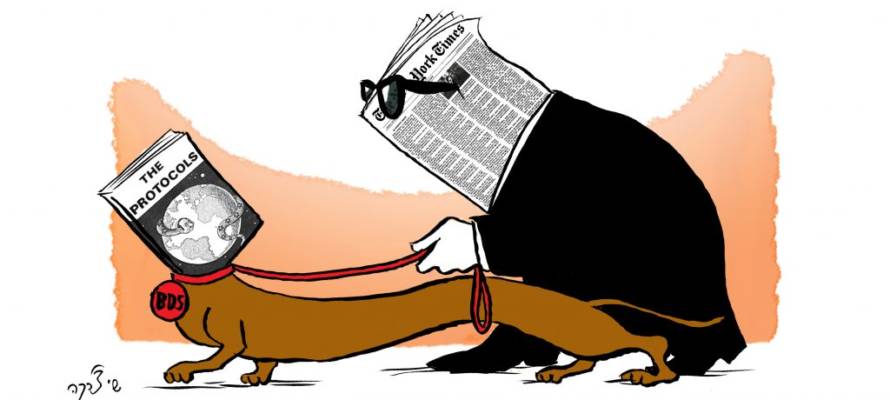
(2) Lobby attacks NYT over Left-Anti-Semitic cartoons; but Cartoonist
defends them
https://www.breitbart.com/politics/2019/04/29/new-york-times-suspends-all-future-syndicated-cartoons-amid-antisemitism-crisis-inside-newspaper/
New York Times Suspends All Future Syndicated Cartoons Amid Antisemitism
Crisis Inside Newspaper
MATTHEW BOYLE
29 Apr 2019
Washington, D.C.604 10:19
The New York Times has suspended the publication of all future
syndicated political cartoons in its international print edition, the
newspaper’s spokeswoman Eileen Murphy confirmed late Monday. The Daily
Beast’s Lloyd Grove spoke with Murphy in the wake of the newspaper’s
publication of a second controversial cartoon that drew critical
condemnation from the Jewish community–after a first cartoon, which the
paper now admits was antisemitic, was retracted and then subsequently
apologized for over the weekend.
The newspaper is in a full internal crisis on this matter, as executives
and editors have launched a full-scale internal investigation into what
happened, who is responsible, and what procedural and structural changes
need to take place so the Times does not publish more antisemitic content.
It all started last Thursday when the Times published a cartoon on the
opinion pages of its international print edition showing Israeli Prime
Minister Bibi Netanyahu as a dog with a Star of David around his collar
on a leash leading U.S. President Donald Trump–depicted as blind and
wearing a skullcap–around.
Under immense criticism, the Times on Saturday retracted the cartoon and
issued an "editor’s note" in response admitting it was antisemitic and
an "error in judgement to publish it."
"A political cartoon in the international print edition of The New York
Times on Thursday included anti-Semitic tropes, depicting the prime
minister of Israel as a guide dog with a Star of David collar leading
the president of the United States, shown wearing a skullcap," the
initial editor’s note on Saturday retracting the image reads. "The image
was offensive, and it was an error of judgment to publish it. It was
provided by The New York Times News Service and Syndicate, which has
since deleted it." ...
Under immense pressure from critics including President Trump’s son
Donald Trump, Jr., and Prime Minister Netanyahu’s son Yair
Netanyahu–among many others–the Times finally on Sunday apologized for
the "error in judgment" in a follow-up statement to the first editor’s
note. The apology reveals a few new facts, including that there is a
mass internal investigation into the matter, that the Times is blaming a
single editor for the mistake but not naming said editor, and that the
Times is promising "significant changes" to its newsroom structure to
prevent future mistakes like this.
The New York Times said in its apology statement, the second official
newspaper statement on this matter:
We are deeply sorry for the publication of an anti-Semitic political
cartoon last Thursday in the print edition of The New York Times that
circulates outside of the United States, and we are committed to making
sure nothing like this happens again. Such imagery is always dangerous,
and at a time when anti-Semitism is on the rise worldwide, it’s all the
more unacceptable. We have investigated how this happened and learned
that, because of a faulty process, a single editor working without
adequate oversight downloaded the syndicated cartoon and made the
decision to include it on the Opinion page. The matter remains under
review, and we are evaluating our internal processes and training. We
anticipate significant changes.
But then, on Monday, it was revealed that in the weekend edition of the
Times international edition published on Saturday–meaning it hit
newsstands before the Times officially retracted the original
antisemitic cartoon–the Times had published a second anti-Israel cartoon
that has come under similarly significant scrutiny from the pro-Israel
community.
Jonathan Greenblatt, the CEO of the Anti-Defamation League (ADL), called
the second cartoon from the Times "insensitive" and "inappropriate":
Jonathan Greenblatt ? @JGreenblattADL This is insensitive,
inappropriate, and offensive. It shows once again that the @NYTimes
needs to educate its staff about #antiSemitism. We call on them to take
immediate action.
Other Jewish leaders like The Jewish Voice went further, calling the
second one antisemitic like the first one:
theJewish Voice ? @JewishVoice ANOTHER antisemitic cartoon from the
@nytimes.
Protest outside of NY Times headquarters tonight on 8th Avenue at 5:30 P.M.
H/T: @StopAntisemiti3
The Reagan Battalion ? @ReaganBattalion So the @nytimes removed the
original anti-Semitic cartoon and replaced it with a different
(anti-semitic) cartoon two days later.
For hours on Monday after Breitbart News originally reached out to
Murphy’s co-worker and fellow Times spokeswoman Danielle Rhoades-Ha on
Monday morning, the newspaper remained silent on the second cartoon. But
now, in a statement from Murphy to the Daily Beast late Monday evening,
the Times–while claiming the second cartoon is not as bad as the first
cartoon–is in the wake of this revelation completely suspending all
cartoon publication.
"The cartoon that ran in the international print edition of The Times
last Thursday was clearly anti-Semitic and indefensible and we apologize
for its publication," Murphy told the Daily Beast. "While we don’t think
this [second] cartoon falls into that category, for now, we’ve decided
to suspend the future publication of syndicated cartoons."
Murphy’s comments on the second Times cartoon come in response, the
Daily Beast’s Grove wrote, to criticisms that ADL’s Greenblatt leveled
in an interview with the Daily Beast about the Times‘ misconduct.
"It looked like the Ten Commandments," Greenblatt said of the second
cartoon, "It might not be as blatantly anti-Semitic as the first
cartoon, but it was clearly insensitive and absolutely offensive after
the first piece of propaganda."
Some experts have noted that the first cartoon resembles literal Nazi
propaganda cartoons from 1940 that show a Jewish man on a leash leading
British Prime Minister Winston Churchill around:
Kay Wilson @kishkushkay Pic 1: The Jew leads Winston Churchill. Nazi
Germany 1940.
Pic 2: The Jew leads #DonaldTrump @nytimes USA 2019.
12.5K 10:04 AM - Apr 28, 2019
Greenblatt told the Daily Beast that the Times‘ apology was "a good
start but it’s insufficient," adding: "We need action and
accountability. We don’t need apologies at this point."
Interestingly, the Times continues to refuse to publicly name the editor
it says made the decision to publish the first antisemitic cartoon and
has provided scant details about the publication process for the second
cartoon.
In its own piece on the matter published under New York Times reporter
Stacy Cowley’s byline on the business pages of the Times, the Times
explained a little more detail about where it came from and how the
process played out with the publication of this cartoon.
Cowley wrote:
The cartoon was drawn by the Portuguese cartoonist António Moreira
Antunes and originally published by Expresso, a newspaper in Lisbon. It
was then picked up by CartoonArts International, a syndicate for
cartoons from around the world. The New York Times Licensing Group sells
content from CartoonArts and other publishers along with material from
The New York Times to news sites and other customers. The Times’s United
States edition does not typically publish political cartoons and did not
run this one, but the international edition frequently includes them. An
editor from The Times’s Opinion section downloaded Mr. Antunes’s cartoon
from the syndicate and made the decision to publish it, according to Ms.
Murphy.
The Times‘ own piece noted that the Times is declining to publicly
identify the editor it says is responsible.
"Ms. Murphy declined to identify the editor, who she said was ‘working
without adequate oversight’ because of a ‘faulty process’ that is now
being reviewed," Cowley wrote, quoting the Times spokeswoman Eileen
Murphy. "‘We are evaluating our internal processes and training,’ Ms.
Murphy said. ‘We anticipate significant changes.'"
Cowley also quoted the editor of all Times editorial page content, James
Bennet, as declining to comment further on what happened or who was
responsible for it. "James Bennet, the editor who oversees all content
on The Times’s editorial pages, declined to comment in detail," Cowley
wrote. "‘I’m going to let our statement speak for us at this point,’ Mr.
Bennet said."
Greenblatt, in his interview with the Daily Beast, said that the Times‘
efforts to pass this off as some kind of "clerical error" are not likely
an accurate description of what happened.
Greenblatt said:
They absolutely need policies and procedures. They need a clarification
about how these decisions get made. And the person who would make such a
decision to publish a cartoon like that, I think it’s kind of obvious
that they don’t have the judgment that’s necessary to be in an
institution like the Times… I think they need a thorough review and an
overhaul of how those decisions get made. I don’t know, was it one
person? Multiple people? I don’t think it’s very clear at this point.
This wasn’t a misjudgment, it was a moral failing. It wasn’t a clerical
error.
All of this comes in the wake of multiple investigative reports by
Breitbart News on this matter, and continued public pressure from the
pro-Israel community. The latest and highest profile criticism of the
Times‘ antisemitism came from Ron Dermer, the Israeli ambassador to the
United States, who at a public event on Monday in remembrance of the
Holocaust bashed the Times as a "cesspool" of hatred.
"We have… seen one of the world’s most prestigious newspapers become a
cesspool of hostility towards Israel that goes well beyond any
legitimate criticism of a fellow, imperfect democracy," Dermer said:
The same New York Times that a century ago mostly hid from their readers
the Holocaust of the Jewish people has today made its pages a safe space
for those who hate the Jewish state. Through biased coverage, slanderous
columns and anti-Semitic cartoons, its editors shamefully choose week
after week to cast the Jewish state as a force for evil.
Through Rhoades-Ha, the Times has not replied to requests for comment in
response to Dermer’s criticisms against the newspaper. But the New York
Post quotes an anonymous spokesperson to the Times, who also confirmed
the news that the Times was cutting off its cartoon service, as
declining to respond to Dermer.
"On Monday, a Times spokesperson told The Post that the paper has
‘suspended the future publication of syndicated cartoons,'" the Post’s
Ben Feuerherd wrote late Monday. "The Times did not immediately respond
to the ambassador’s comments.
Meanwhile, despite all of this and as the mess continues to grow and
spread deeper into the Times newsroom, the Daily Caller reports–citing a
Portuguese newspaper–that the cartoonist behind the original first
antisemitic cartoon from last Thursday has now come forward to defend
his work.
"It is a critique of Israeli policy, which has a criminal conduct in
Palestine, at the expense of the UN, and not the Jews," the cartoonist
António Moreira Antunes, who according to the Caller’s report goes
simply by "Antonio," said in an interview with the Portuguese newspaper
where he works, Expresso. The interview and article from Expresso was
published in Portuguese.
As the Times continues its investigation, the newspaper keeps not
answering the critical questions of who exactly was responsible for
publishing these two cartoons–particularly the first one–and whether
that person or those persons will face any consequences whatsoever, up
to and including termination. The Times also has not answered what exact
structural reforms it will implement internally to prevent this from
happening again, and the Times has not replied when asked if it will, in
the interest of transparency, make its entire internal investigation’s
findings–including underlying source materials like interview
transcripts or notes, emails, and text messages–publicly available so
its readers can see what happened.
Greenblatt, in his interview with the Daily Beast, called on the
newspaper to "institute sensitivity training for the staff on
anti-Semitism."
"Clearly they need it, to make sure they cover these issues with an eye
toward focusing on the facts rather than perpetuating prejudice,"
Greenblatt said. "And thirdly, I think they owe it to their readership
to educate them on the persistent poison of anti-Jewish hate."
The Times spokeswoman, the Daily Beast’s Grove wrote, would not
entertain Greenblatt’s arguments for sensitivity training for all New
York Times staff on antisemitism–or entertain Greenblatt’s push for the
Times to fire the editor it says is responsible for this mishap to begin
with.
"Murphy declined to comment on Greenblatt’s recommendation to start
sensitivity training sessions, or his suggestion that the editor or
editors involved shouldn’t be working for the Times," Grove wrote.
(3) Letters to NYT re Anti-Semitic Cartoons
https://www.nytimes.com/2019/04/29/opinion/letters/anti-semitic-cartoon-new-york-times.html
LETTERS
The Uproar Over an Anti-Semitic Cartoon
Readers react to a political cartoon showing President Trump and
Benjamin Netanyahu that ran in the international edition of The Times.
April 29, 2019
Re "Times Apologizes for Printing Anti-Semitic Cartoon" (Business Day,
April 29):
We write you deeply concerned about the reprehensible cartoon published
in your international print edition depicting Israel’s prime minister,
Benjamin Netanyahu, as a guide dog for a blind President Trump.
Under the guise of political commentary, the caricature blatantly
trafficked in age-old anti-Semitic tropes that have contributed to
violence against Jews throughout history. How cruelly ironic that your
cartoon was published the week of another synagogue shooting.
Given the frightening rise in anti-Semitism around the globe today, your
paper must exercise much greater judgment in recognizing the boundaries
of acceptability.
Angela Buchdahl Elliot Cosgrove Joshua M. Davidson Peter J. Rubinstein
New York The writers are rabbis at, respectively, Central Synagogue,
Park Avenue Synagogue, Congregation Emanu-El of the City of New York and
92Y.
To the Editor:
Re "A Despicable Cartoon in The Times" (column, April 29):
I completely agree with Bret Stephens that it’s a "despicable" cartoon.
I saw the actual cartoon when a friend living abroad shared it on social
media and was shocked that a respected newspaper would publish such
obvious anti-Semitic propaganda.
The cartoon is reminiscent of Nazi propaganda in its style and message.
It plays to rabid anti-Semitism, which has seen a frightening resurgence
in the United States and in Europe.
This is your last free article. Subscribe to The Times If the political
message of the cartoon was to decry President Trump’s acquiescence to
Prime Minister Benjamin Netanyahu’s demands, why the Jewish — rather
than Israeli — symbolism? This cartoon is a very obvious expression of
age-old anti-Semitic sentiment, the belief that a Jewish cabal secretly
controls the world’s political and financial systems with world leaders
too blind to see that they are being led by Jews.
I am not writing this as a supporter of the Netanyahu government, or of
its policies toward Palestinian territories. A legitimate criticism of
those policies would be a totally appropriate topic for political
commentary or a cartoon. This is obviously not such commentary, and it
has no place in any newspaper.
Deborah Majerovitz Brooklyn
To the Editor:
I was able to find the cartoon online and can see why some people might
view it as distasteful. But anti-Semitic, I’m not sure. The cartoon
appears to me to be a direct criticism of President Trump and the way he
has unquestionably supported Benjamin Netanyahu, not just in the recent
hotly contested Israeli election but in abandoning the nuclear treaty
with Iran.
If some folks perceive it as anti-Semitic, they are free to do so. But I
don’t see why criticism of Mr. Netanyahu (or Israel) has to be viewed as
anti-Semitism. The cartoon itself might be in bad taste and terribly
offensive, as is the growing anti-Semitism in Europe and elsewhere, but
it appears to be legitimate criticism of two flawed national leaders and
not of a religion and its supporters.
Michael Barrett Reston, Va.
To the Editor:
I would like to thank Bret Stephens for his thoughtful column and thank
The Times for publishing this self-criticism.
There is one nuance that I would like to point out. Mr. Stephens writes:
"So long as anti-Semitic arguments or images are framed, however
speciously, as commentary about Israel, there will be a tendency to view
them as a form of political opinion, not ethnic prejudice."
However, it’s important to leave open the ability to forcefully
criticize Benjamin Netanyahu without the suggestion that one is being
either anti-Zionist or anti-Israel or, worse yet, anti-Semitic. Mr.
Netanyahu is not the State of Israel, does not encompass all that is
Zionist and does not represent all Jews. To suggest otherwise is
equivalent to portraying criticism of President Trump as anti-American.
L. Ross New York
A version of this article appears in print on April 30, 2019, on Page
A22 of the New York edition with the headline: Uproar Over an
Anti-Semitic Cartoon.
(4) New York Times slammed for another Netanyahu cartoon days after
'anti-Semitic' sketch
https://www.foxnews.com/entertainment/new-york-times-slammed-for-another-netanyahu-cartoon-days-after-anti-semitic-sketch
By Victor Garcia
After apologizing over the weekend for publishing a syndicated cartoon
with "anti-Semitic tropes" in its depiction of Israeli Prime Minister
Benjamin Netanyahu and President Trump, The New York Times was
criticized again Monday over yet another caricature of Netanyahu.
Dan Senor, a former Pentagon aide and advisor to Mitt Romney and Paul
Ryan, called out the "paper of record" for printing another
anti-Netanyahu cartoon, this time depicting him as a blind Moses-like
figure holding a tablet with the Israeli flag on it instead of the Ten
Commandments.
TRUMP BLASTS NEW YORK TIMES REPORTING, SAYS PAPER WILL BE GONE 'IN 6 YEARS'
Dan Senor ? @dansenor Wait...the ?@nytimes? featured ANOTHER Netanyahu
cartoon? This one AFTER the Thursday cartoon depicting Netanyahu as a
dog? Am I reading this right? Is the Times obsessed with Israel’s prime
minister?
3,056 9:56 PM - Apr 29, 2019 1,930 people are talking about this Twitter
Ads info and privacy "Wait...the ?@nytimes? featured ANOTHER Netanyahu
cartoon? This one AFTER the Thursday cartoon depicting Netanyahu as a
dog? Am I reading this right? Is the Times obsessed with Israel’s prime
minister?" Senor tweeted.
The cartoon appears to have been published this weekend in the
international edition of the paper, the same edition that printed
Thursday's cartoon.
Jonathan Greenblatt, the CEO and national director of the
Anti-Defamation League (ADL) called on the Times to take "immediate
action" over the new cartoon.
"This is insensitive, inappropriate, and offensive. It shows once again
that the @NYTimes needs to educate its staff about #antiSemitism. We
call on them to take immediate action," Jonathan Greenblatt tweeted Monday.
Jason D. Greenblatt, assistant to President Trump, demanded to know why
another controversial cartoon was published.
"Confounded & shocked by another terrible decision by @NYT. As our
nation is grieving the deadly attack in #Poway, how did a cartoon like
this make it into their paper...again?! We need answers!" Jason
Greenblatt tweeted.
Requests for comment were not immediately returned by the Times.
The New York Times Opinion section issued a second apology Sunday over a
cartoon of President Trump and Israeli Prime Minister Benjamin Netanyahu
which had been criticized.
"We are deeply sorry for the publication of an anti-Semitic political
cartoon last Thursday in the print edition of The New York Times that
circulates outside of the United States, and we are committed to making
sure nothing like this happens again," the opinion section tweeted Sunday.
"Such imagery is always dangerous, and at a time when anti-Semitism is
on the rise worldwide, it's all the more unacceptable," continued the
apology, which was widely shared on Twitter.
The new apology said that the decision to run the syndicated cartoon was
made by a single editor working without adequate oversight.
Thursday's cartoon showed Trump wearing a pair of sunglasses and being
led by a dog depicted as Netanyahu. The dog had a Star of David collar.
The cartoon appeared in the paper’s opinion section next to a column
penned by Thomas Friedman.
Fox News' Frank Miles contributed to this report.
(5) Cartoonist Defends Anti-Semitic New York Times Cartoon
https://dailycaller.com/2019/04/29/cartoonist-defends-anti-semitic-nyt-cartoon/
7:22 PM 04/29/2019
Mike Brest
The cartoonist who drew the anti-Semitic caricature of President Donald
Trump and Israeli Prime Minister Benjamin Netanyahu defended his work
Monday in a Portuguese newspaper.
The cartoon in question, which appeared in Thursday’s New York Times
international paper, featured Israeli Prime Minister Benjamin Netanyahu
as a dog with a Star of David collar leading a blind Trump, who is
wearing a yarmulke. There was no caption or text alongside the caricature.
"It is a critique of Israeli policy, which has a criminal conduct in
Palestine, at the expense of the UN, and not the Jews," said António
Moreira Antunes, who goes by António, in an interview with Expresso, a
Portuguese paper where he works.
NYT cartoon labeled anti-Semitic (Twitter screenshot from Zemer Mizrahi)
NYT cartoon labeled anti-Semitic (Twitter screenshot from Zemer Mizrahi)
"The reading I made is that Benjamin Netanyahu’s politics, whether by
the approach of elections or by being protected by Donald Trump, who
changed the embassy to Jerusalem by recognizing the city as capital, and
which first allowed the annexation of the Golan Heights and after the
West Bank and more annexations in the Gaza Strip, which means a burial
of the Oslo Accord, it represents an increase in verbal, physical and
political violence," he continued. "It is a blind policy that ignores
the interests of the Palestinians. And Donald Trump is a blind man The
Star of David [Jewish symbol] is an aid to identify a figure [Netanyahu]
that is not very well known in Portugal."
The New York Times issued two separate editor’s notes Saturday and
Sunday respectively.
It says in part, "We are deeply sorry for the publication of an
anti-Semitic political cartoon last Thursday in the print edition of The
New York Times that circulates outside the United States, and we are
committed to making sure nothing like this happens again."
Dan Senor ? @dansenor Wait...the ?@nytimes? featured ANOTHER Netanyahu
cartoon? This one AFTER the Thursday cartoon depicting Netanyahu as a
dog? Am I reading this right? Is the Times obsessed with Israel’s prime
minister?
3,057 9:56 PM - Apr 29, 2019 1,933 people are talking about this Twitter
Ads info and privacy Since then, the Times published another cartoon of
Netanyahu. This one depicts a blind Netanyahu holding a tombstone that
has an Israeli flag drawn on it.
The backlash surrounding the Times’ cartoon coincided with a terror
attack that left one person dead when a man opened fire Saturday inside
a California synagogue. (RELATED: One Dead, Several Injured In Shooting
At San Diego Synagogue)
The Times did not respond to a request for comment about Antonio’s comments.
(6) Israeli Cartoonist Responds with Anti-New York Times Cartoon
https://unitedwithisrael.org/israeli-cartoonist-responds-with-anti-new-york-times-cartoon/
Apr 29, 2019
The caricature depicts a dog with a book called The Protocols leading an
individual with the New York Times in place of his head.
By United With Israel Staff
After the New York Times published an anti-Semitic caricature last week,
an Israeli cartoonist has responded i the Makor Rishon newspaper with
the title: "No Clarification Necessary."
The Times cartoon appeared on Thursday in the international edition of
the newspaper. It depicted Prime Minister Benjamin Netanyahu as a dog
with a Star of David around his neck leading a blind U.S. President
Donald Trump wearing a skullcap.
The response from cartoonist Shay Charka was a caricature of a dog as
well, but this time, instead of the face of the Israeli prime minister,
it depicts a book called The Protocols, an obvious reference to the
Protocols of the Elders of Zion, an infamous work of fiction blaming
Jews for a supposed conspiracy to dominate the world.
Around this dog’s neck are the letters BDS, the acronym for the
anti-Israel "Boycott, Divestment, Sanctions" movement.
Being led by the dog in this cartoon is an individual with a copy of the
New York Times in place of his head.
The New York Times has apologized for the cartoon, claiming that a
single editor was responsible.
Send Passover Food Packages to Needy Israeli Soldiers
We are honored to thank the young men and women of the IDF who risk
their lives to protect the citizens of Israel. Join us in sending
Passover food packages (and personal notes) to needy Israeli soldiers
and their families.
Bring Passover joy and blessing to the heroes of Israel who defend our
freedom every day! Many soldiers spend the Passover holiday with needy
families back home. The soldiers greatly appreciate your love and concern.
(7) Jeff Blankfort (Facebook): In the 1980s, many cartoons likened
Israel to Nazi Germany & South Africa
https://www.facebook.com/jeff.blankfort
Jeff Blankfort 1 hr · Tuesday humor from the Jewish Insider:
On Monday evening, the New York Times announced it had decided to cease
its relationship with the syndication service that supplied the cartoon.
The decision came after ADL CEO Jonathan Greenblatt submitted a
complaint about a second cartoon appearing to denigrate the faith of
Israeli Prime Minister Benjamin Netanyahu and published over the weekend
in the paper’s international edition. "It might not be as blatantly
anti-Semitic as the first cartoon, but it was clearly insensitive and
absolutely offensive after the first piece of propaganda," Greenblatt
explained to the Daily Beast.
During last night's NYU panel, Bret Stephens said that writing his op-ed
in response to the antisemitic cartoon in the paper’s international
print edition last week was an easy choice.
"The moment I saw the cartoon, I realized, I’m either going to denounce
it or feel ashamed of myself," he said. "It was an emotional decision,
it was easy. But most importantly it was easy because the senior
leadership at the Times — the editorial page editor James Bennet, and
people, in fact, more senior to him — were horrified by the publication
of the cartoon. It took them by surprise. These things happen at
newspapers, and even if they didn’t agree with every word that I wrote,
they understood that it was essential that the paper of record also
provide the most biting criticism of the cartoon." [JewishInsider]
Jeff Blankfort
I posted the following on another link but it's apt here:
In the 80s, both during Israel's invasion of Lebanon and during the
First Intifada, there were many cartoons in the mainstream US media
which pilloried Israel in a manner that made both of these cartoons seem
tame. I reproduced some in the Middle East Labor Bulletin and the ADC
put them together in a pamphlet.
They compared Israel with Nazi Germany and South Africa, playing up the
IDF's sadism, strung the star of David with barb wire and one, by
Oliphant, showed Uncle Sam stripped of his shirt with a chain around his
neck held by Menachem Begin.
One, that I suggested to Kent Conrad, a legendary LA Times cartoonist,
depicted a religious Jew, standing on the back of a bent over
Palestinian carrying a sign that said, "Free Soviet Jews." That drew a
round the block protest from local Jews but no apology from the Times.
At the same time, articles critical of Israel, some from Ha'aretz would
appear in the op ed pages as well as interviews with critics of Israel.
Robert Fisk' articles were routinely republished.
But then, Israel's 5th Column tightened the screws and all of it,
cartoons and commentaries disappeared.
(8) Israeli rabbis at military prep school are caught on video praising
Hitler
https://mondoweiss.net/2019/04/israeli-military-praising/
Jonathan Ofir on April 30, 2019
Yesterday, Israeli Channel 13 aired video recordings by rabbi educators
at the state-sponsored military prep-academy Bnei David in the West Bank
settlement of Eli. The rabbis hail Hitler’s Nazi racist ideology as
"100% correct", only criticizing it for not being applied to the right
people – that is, the Jews should be the master-race, and non-Jews the
‘untermenschen’.
The statements are jaw-droppers. The full coverage with subtitles can be
seen in a video prepared by journalist David Sheen.
These educators send young men to the army, and have been advocating
these ideas for years. They have close ties to lawmakers, specifically
to Rabbi Rafi Peretz, now head of the Union of Right Wing Parties, the
notorious merger with the Kahanist party Jewish Power, who is now the
leading candidate for Minister of Education. The academy is also tied to
a Yeshiva, to which many students come after their military service.
Slavery should return
It starts out with Rabbi Eliezer Kashtiel, who bemoans that slavery has
been abolished:
Abolishing legal slavery has created deficiencies. No one is responsible
for that property. With God’s help it will return. The goyim (non-Jews)
will want to be our slaves. Being a slave of the Jews is the best. They
must be slaves, they want to be slaves. Instead of just wandering the
streets, being foolish and harming each other, now he’s a slave, now his
life is beginning to come into order.
The ‘goyim’ in this context is to be understood as Palestinians.
He says it’s because they have "genetic problems", and posits that they
want to be under occupation:
There are around us people with genetic problems. Ask any average Arab
where he wants to be. He wants to be under occupation. Why? Because they
have genetic problems, they don’t know how to run a country, they don’t
know how to do anything – look at the state of them.
Yes, we are racists
"Of course there is racism", Kashtiel continues.
Are we unaware that there are different races? Is it a secret? Is it
untrue? What can you do? It’s true. Yes, we are racists, we believe in
racism.
Kashtiel suggests that because Jews are a superior race, they can "help"
the inferior ones:
Correct, there are races in the world, nations have genetic
characteristics, so we [the Jews] must consider how to help them. Racial
differences are real, and that’s precisely a reason to offer help.
A student asks the rabbi: "Who put you to decide who is who?"
Kashtiel:
I can see that my accomplishments are much more impressive than his.
The Holocaust is humanism and pluralism
Another rabbi, Giora Radler, says that the Holocaust is not what you
think, it’s not about killing Jews. It is humanism and pluralism that is
killing us for real:
The Holocaust for real is not about the killing of Jews – that’s not the
Holocaust. All of these excuses claiming that it was based on ideology
or that it was systematic, this is ridiculous. Because it was based on
ideology, to a certain extent, makes it more moral than if people
murdered people for no reason. Humanism, all the secular culture about
us believing in the human, that’s the Holocaust. The Holocaust, for
real, is being pluralist, believing in "I believe in the human". That’s
what’s called a Holocaust. The Lord (blessed be his name) is already
shouting for many years that the [Jewish] exile is over, but people
don’t listen to him, and that is their disease, a disease which needs to
be cured by the Holocaust.
In other words, the Holocaust was there to teach Jews a lesson – drop
pluralism, isolate yourself in the Jewish State and let go of the
diaspora "illness".
These remarks were made in a lesson titled "relating to the Holocaust".
The Nazi logic was right
Radler:
The Nazi logic was right unto themselves. Hitler says that a certain
group in society is the seed of all calamity for all humanity, that
because of it all of mankind will go to oblivion, that they harm
humanity, and therefore must be exterminated.
Radler asks a student: "Does this ideology sound illogical to you? Very
bad?"
Student answers: "It doesn’t sound moral."
Radler: "Was Moses as bad as Hitler?"
Student: "No."
Radler:
Why not? There is one thing in the world that is truly evil and that is
to be a hypocrite. Does it make a difference to you if they killed you
now with a knife the way they did to Agag [the Amalekite king whom the
prophet Samuel ‘hacked in pieces’] or if they kill you in a gas chamber?
Hitler was right, "100% correct"
Radler goes on to speak about Hitler, and now adds that the disease is
not just pluralism and humanism, but also feminism, and that Hitler was
absolutely right:
"Let’s start with the question whether Hitler was right or not".
Student: "Not".
Radler:
[Hitler] is the most righteous person. Of course he is right in every
word he utters. In his ideology he is right. There is a male world which
fights, which deals with honor and the brotherhood of soldiers. And
there is the soft, ethical feminine world [which speaks of] ‘turning the
other cheek’. ‘And we [Nazis] believe that the Jews carry on this
heritage, trying, in our words, to spoil the whole of humanity, and
that’s why they are the real enemy.’ Now, he [Hitler] is 100% correct,
aside from the fact that he was on the wrong side.
So here, Radler was emulating Hitler, mouthing Nazi arguments
approvingly. The only fault of the Nazis, per Radler, was that they
didn’t know who the real master race was, and who the real
‘untermenschen’ were. The Nazis couldn’t be right, because only Jews
could be the superior ones. But if Jews now apply this race theory and
ideology currently – that is, essentially upon Palestinians, then they
would really be "100% correct" – maybe even "101%", because they got it
even more right than Hitler.
Responses
This is a big mouthful. Real Judeo-Nazism.
The rabbis were contacted for response and tried to whitewash the whole
thing as a misunderstanding.
Rabbi Kashtiel said that he was "sorry and at pain that a class on human
rights got the opposite exposure to what it means, a modern-socialist
understanding of slavery."
Rabbi Radler said that his words were "taken out of context" and that
the lesson about the Holocaust "seeks to explain the sick logic of
Hitler as well as the reasons and motives for the Holocaust".
Israeli-Palestinian lawmaker Ahmad Tibi responded to the airing: "In
German it would have sounded more authentic".
Of course, Zionist Israeli politicians were also alarmed. Centrist
lawmaker Yair Lapid wrote on Twitter:
This is not Judaism. These are not values. People who speak like this
are not worthy of educating youths.
Lapid called for halting the state financing of the Yeshiva "until the
racist rabbis are expelled". But there’s a problem here, because
Lapid’s own ideology is about "maximum Jews on maximum land with maximum
security and with minimum Palestinians", and although Lapid points out
now that "secular people established Israel", really, his religion is
the ultra-nationalist Zionism, and he is just a slightly prettier face
of that Judeo-Nazism we see emanating from Bnei David.
Leftist Meretz leader Tamar Zandberg:
The Eli academy should have been closed long ago, and whoever let the
chauvinism, homophobia and all the rest of the hate which comes out of
there to continue the madness, should not be surprised by the horrible
expressions which came out of there today.
Zandberg said she applied to the education ministry to stop funding the
academy.
But the Eli Yeshiva and academy are now closely tied with the
government. It was the Yeshiva head rabbi Eli Sadan, who campaigned for
Rafi Peretz to become head of the Union of Right Wing Parties, now the
top candidate for Minister of Education. Peretz was allowed to speak to
the students there before the elections, even as Naftali Bennett (who
until now has been Minister of Education) and Prime Minister Netanyahu
were refused.
In other words, there is a whole political reality that is even more
radical than both Netanyahu and even Bennett, who was considered
extreme-right, one that really does speak of Jewish power, in an overtly
fascist, literally Nazi, vein. And this ideology is poised to gain a
central place in the Israeli government.
Not a slip of the tongue
As the Channel 13 coverage also notes, what we have heard here is no
slip of the tongue:
"These statements have been repeated again for years at Bnei David. Not
a slip of the tongue, but a set agenda."
And Bnei David is not an isolated island. A similar story of a genocidal
educator of security forces is rabbi Dov Lior from the settlement Kiryat
Arba, who endorsed the book Torat Hamelech (‘King’s Torah’) of 2009,
which advocates the killing of non-Jewish babies since "it is clear they
will grow to harm us". Lior has been teaching police forces in a special
program for religious recruits called ‘Believers in the Police’. The
authors of the book, by the way, are from the Od Yosef Chai Yesiva in
the settlement of Yitzhar, a Yeshiva that received funds from Jared
Kushner’s family’s foundation until 2011. Views of the Holocaust as a
divine punishment for sinners have been expressed by the former chief
Sephardic rabbi Ovadia Yosef, who also believed that the purpose of
non-Jews is to serve Jews, and he likened non-Jews to donkeys.
It is possible that the above mentioned airing of shocking views may
cause a certain temporary and local stir, but this ideology is deeply
embedded, and now an integral part of a central Israeli political
reality. It is clear that the rabbis treat this attention as a nuisance
by liberals who have no understanding, and it is likely that they will
regard this as an unfortunate ‘Azarya’ – like the soldier medic who was
filmed murdering an incapacitated Palestinian at point blank range three
years ago and had to spend some months in prison. The problem for
Azarya’s supporters wasn’t the murder – but the video. And so these
people may find ways to crawl out of this debacle, but they will
continue believing in the righteousness of their Jewish supremacy.
H/t Ofer Neiman, Richard Silverstein, David Sheen
About Jonathan Ofir
Israeli musician, conductor and blogger / writer based in Denmark.
(9) Marc Ellis bases his Theology of Liberation on the Exodus narrative
https://mondoweiss.net/2019/04/nopassover-reflections-liberation/
‘Thou shalt not murder those who resist your oppression’:
#NoPassover reflections on a Jewish theology of liberation
Marc H. Ellis on April 29, 2019
The following is a speech given on the panel "Exploring Liberation
Theology in the Palestinian Struggle" during the International
Conference on Palestine held at the Center for Islam and Global Affairs,
I?stanbul Sabahattin Zaim Üniversitesi, Istanbul Turkey, April 27-29.
This post is part of Marc H. Ellis’s "Exile and the Prophetic" feature
for Mondoweiss. To read the entire series visit the archive page.
Two years ago in Jerusalem, I celebrated the 30th anniversary of my
book, Toward a Jewish Theology of Liberation. Though I use the word,
"celebrated," noting that my book is still relevant in our fast moving
times, the very relevance of my book occasioned a mourning. In the
decades since its publication regression in Israel-Palestine rather than
progress has been the watchword. What has unfolded during these decades
is decisive. It has rendered the occupation of Palestine permanent. It
has brought us to the end of ethical Jewish history – from which there
will be no return.
When I launched my Jewish Theology of Liberation I was unknown in Israel
and elsewhere. I remember wondering why the audience was overflowing.
The atmosphere was tense. Something was in the air. In Jerusalem, I
called for a (real) two state solution, with East Jerusalem as the
capital of Palestine. I called for the Prime Minister of Israel to
confess to the Palestinian people the following: "What we, as Jews, have
done to you, the Palestinian people, is wrong. What we, as Jews, are
doing to you, the Palestinian people, is wrong. We pledge to you a new
beginning. Let us take the road of justice and equality into the
future." I called for Israel, with the help of Jews around the world, to
pay reparations to the Palestinian people. To put it mildly, my words
were controversial.
Months after my book launch the Palestinian Uprising began. In 1989, a
second edition was issued with a new Epilogue: "The Palestinian Uprising
and the Future of the Jewish People." During this time I wrote a sequel,
published in 1990, with a three part title that still resonates: Beyond
Innocence and Redemption: Confronting the Holocaust and Israeli Power:
Creating a Moral Future for the Jewish People. With the Great March of
Return and the recent Israeli elections, the thoughts contained in both
books remain ingrained in Jewish history, albeit with a terrible twist:
Within a permanent occupation, at the end of ethical Jewish history,
what is the future for Jews and Palestinians?
My Jewish Theology of Liberation begins with the Exodus narrative. In
the Biblical account, Jewish nationality, culture and religiosity are
forged in an act of liberation enacted by a liberating God. For me,
though, the Exodus points to a more important fact about Jewish history:
that the prophetic, which reappears in the Land, is our Jewish
indigenous. The critique of unjust power, especially within our own
community, is the litmus test for the affirmation of God. Put simply: In
Jewish life, No justice, No God.
With the creation of the state of Israel the equation of justice and God
was already under assault. This is why that, after mentioning the
Exodus, I shifted to the contemporary formative event of Jewish history,
the Holocaust. Where was God and the prophetic at Auschwitz?
The state of Israel is a response to the twists and turns of European
Christian history, culminating in the Holocaust. Yet in Israel’s birth a
terrible evil was committed, the ethnic cleansing of Palestinians. In
Toward a Jewish Theology of Liberation, I affirm Jewish empowerment
after the Holocaust but question the cost of Israel’s empowerment. At
the same time, I point to an ethical path to redress the wrong done in
the creation of Israel.
The first Palestinian Uprising represented the possibility for a
reckoning and forward movement. In the decades since, Israel, with the
assistance of the Jewish establishment in America and, surprisingly with
the help of progressive Jews as well, foreclosed that possibility. Over
the years both groups insured there would be no way forward.
A Jewish Theology of Liberation questioned what was occurring in the
Jewish community in the United States. In the 1950s and 1960s, the
Jewish community was among the most liberal communities in America – on
civil and women’s rights and on economic, political and international
affairs. As the 1980s arrived, Jewish liberalism tacked right;
neo-conservatism became the hallmark of Jewish thought and commitment. I
wondered about this drift and the reasons for it. Part of my Jewish
Theology of Liberation centered on the question: Is the neoconservative
drift of the American Jewish community occasioned and furthered by the
increasing centrality of the Holocaust and Israel to Jewish identity?
Many of these understandings of Israel and the world come within a
consciousness that endures today and is formative. Though highly
political in its outward manifestations, it takes on an ultimate
concern, one might say a theological one. In a Jewish Theology of
Liberation, I identify this consciousness as Holocaust Theology.
Holocaust Theology begins in the 1960s and solidifies after the 1967
Arab-Israeli war. Whether justified or not, large parts of the Jewish
world felt in the weeks before the 1967 war that the very existence of
Israel was on the line. Many Jews feared that if Israel was defeated,
Jews in Israel would be annihilated; a second Holocaust would occur.
Thus Israel’s swift victory in the war seemed to some more than a
military victory. Those, like Elie Wiesel, who experienced the Holocaust
and feared another one, rejoiced. For Wiesel, victory in the 1967 war
was a miracle in the making, especially after he with other Jews felt
that the world, indeed God, had abandoned Jews during the Holocaust.
Could Israel’s victory in the 1967 war be a redemptive response to the
Holocaust?
Emil Fackenheim, himself briefly imprisoned during the war years,
posited a new commandment in relation to the 1967 war, a commandment
which he believed issued from the "Commanding Voice of Auschwitz" rather
than the "Commanding Voice of Sinai" – "Thou Salt Not Grant Hitler
Posthumous Victories." Elie Wiesel saw Israel’s victory as fueled less
by its military might than by the victims of the Holocaust who, in his
mind, pressed Israel’s forces to victory.
Holocaust Theology became the introduction to my Jewish Theology of
Liberation for a variety of political and religious reasons, though
mostly because it presaged a deep identity shift within the Jewish
people as a whole. Though controversial then and now, Holocaust Theology
speaks to a people brutally assaulted, humiliated, maimed and murdered
in Europe during the Nazi years. It speaks to the survival of an ancient
people and tradition.
At least initially, Holocaust Theology also carried warnings about the
misuse of the power Jews needed and had acquired, though mostly in the
abstract and under a maximum definition of self-defense. Holocaust
Theology does not acknowledge what Jews initially did on the Palestinian
people in the creation of Israel. Nor does it address the injustice
Israel continues to commit against the Palestinian people under a
variety of forms of occupation.
For the most part, Holocaust Theology renders the Israeli occupation of
Palestine and Palestinians themselves invisible. Israel is a Jewish
drama of innocence and redemption. When visible, Holocaust theologians
define Palestinians as challenging the need for Jewish empowerment and,
worse, actively opposing it. Holocaust theologians do not understand the
reasons Palestinians oppose Jewish power except to declare that
Palestinians have a deep animus toward Jews and Jewish history. Within
Holocaust Theology, Jews who argue with Israel’s empowerment, or parts
thereof, are painted with a similar brush. In Holocaust Theology,
Palestinians are mostly seen as anti-Semites. Jews who argue with
Israel’s use of power against Palestinians are defined as self-hating.
The Interfaith Ecumenical Deal that emerges from the dialogue between
Jews and Christians after the Holocaust was important in the early days
of a Jewish Theology of Liberation. After the Holocaust, Jews instructed
Christians to clean up their anti-Jewish theology. Many Christians
wanted to do just that. Part of the dialogue, insisted by Jews, was that
Christians accept Jewish self-definition. This includes Israel as
central to Jewish life. And more, Jews in the dialogue insist Christians
accept the centrality of Israel to Jews as the main vehicle of
repentance for their sin of anti-Semitism. To further this understanding
and imbue it with theological significance, Christians developed a
Christian Holocaust Theology. In Christian Holocaust Theology,
Christians and the Christian covenant are dependent on their Jewish
forerunners and Jewish empowerment, especially in Israel.
Since Jewish Holocaust Theology sees Jews as innocent in suffering and
empowerment, including in the creation and maintenance of the state of
Israel, any criticism of Israel vis-a-vis Israel’s treatment of
Palestinians is deemed a return to anti-Semitism. Quite soon after the
1967 war, the Jewish-Christian dialogue morphed into the Interfaith
Ecumenical Deal. In this deal, Christian repentance for the sins of
anti-Semitism is assured by Christian silence on the plight of Palestinians.
As with Jewish Holocaust Theology, Christian Holocaust Theology and the
Interfaith Ecumenical Deal has a deep and abiding political impact in
Europe, the site of the Holocaust, and in the United States, where an
increasingly empowered Jewish community demands Israel be most favorably
set apart in American foreign policy. Combined with the rise of
Evangelical Christianity in America and in different parts of the world
over the last decades, the concerted effort to suppress the indigenous
Jewish prophetic becomes obvious. Jewish Holocaust Theology is explicit
on this point with a logic spelled out in the following way: "The Jewish
prophetic turned inward threatens the empowerment of Jews, especially in
Israel; Taken to its final demand for justice for the aggrieved, in this
case Palestinian freedom, the Jewish prophetic threatens the very
existence of Israel; In so doing, the Jewish prophetic, intentionally or
not, lays the groundwork for a second Holocaust."
Yet in its inception, and against the odds, a Jewish Theology of
Liberation recognized and was part of the revival of the Jewish
prophetic precisely on the point Jewish Holocaust Theology feared most:
Israel’s unjust power wielded against the Palestinian people. Though
Israel’s invasion of Lebanon and the crushing of the Palestinian
Uprising in the 1980s mark the beginnings of this fracture in Jewish
consciousness, it was during and after the second uprising in 2000 and
beyond that a final prophetic break occurred.
The initial division between what I have called Constantinian Jews or,
if you prefer, Empire Jews, and Progressive Jews, occurred within the
second Palestinian Uprising. Progressive Jews criticized the Jewish
establishment with regard to Palestinians. Yet the criticism was often
paternalistic toward Palestinians and critical of Jews who see the
crisis in Israel-Palestine more critically. The second Palestinian
Uprising confirmed that Progressive Jews essentially functioned as the
Left-wing of Constantinian Judaism.
A third group of Jews, Jews of Conscience, realized that the Israeli
occupation of Palestine is permanently imbedded in Israeli and Jewish
life. Jews of Conscience understand that the Constantinian-Progressive
Jewish axis is complicit in an injustice that will continue. Only by
refusing this axis can Jews and Palestinians be saved from a future
characterized by a permanent occupation and, by definition, the end of
ethical Jewish history.
If we fast forward to the present, the continuing relevance of a Jewish
Theology of Liberation becomes clear. In writings since 1987, I have
narrated the failure of Israel and the Jewish establishments in America
and elsewhere. As well, I have narrated the explosion of Jewish
prophetic movements over the last decades. Attempts at detailing and
expanding a Jewish Theology of Liberation are ongoing and include
critical historical analysis of Israel’s founding, the importance of
international law, the expanding BDS movement and questions about the
coloniality of Israel and Jewish life. Though all have their importance,
they make sense only in the broader framework that a Jewish Theology of
Liberation provides. The central question I raised more than thirty
years ago remains: Has Jewish empowerment in Israel and elsewhere
empowered Jews? Or has the abuse of that empowerment enslaved Jews in
and outside of Israel?
I speak as Passover comes to an end. But this year, as a Jewish Theology
of Liberation enters its fourth decade, with an occupation that has, in
my view, become permanent, I suggested that Passover be, literally,
passed over. In essence, out of conscience, and in light of the
situation in Israel-Palestine, especially but not limited to the maiming
and murdering of Gazans participating in the Great March of Return, I
argued that all attempts at reforming Jewish life, including in the
political and religious arenas, should be suspended. Hence my
#NoPassover signage in my writing running up to Passover this year.
Just days before Passover and a week or so before I boarded the plane
for Istanbul, I read of three young Gazans who attempted to cross back
across the border into what is now Israel. All three were shot by
Israeli soldiers, then held in Israel. Ten days later the lifeless body
of the 16-year-old, Ishaq Abd al-Mu’ti Eshtawi, from Rafah City, was
returned. When I saw the story I wrote in my diary: "The Israeli
soldiers carry the wounded Gazan away. His crime? Trying to return home.
So they shot him and took him in. Now he’s returned. To his other home.
Dead. I ask: When is silence better than empty words of outrage and
deliverance? At least change the subject. Out of respect for the dead
and the living. Who tomorrow might be murdered. #NoPassover."
Sometimes I am asked where would I begin if I were to write a Jewish
Theology of Liberation today from scratch. I could not begin with the
Exodus, since Jewish liberation cannot be a one-sided affair and,
besides, we are now aware of the complications of the Exodus narrative
from a variety of perspectives, including Israel’s Biblical entry into
the land and the consequences for the native inhabitants. I could not
begin with the Holocaust either, since the Holocaust today functions as
a blunt instrument against the aspirations of the Palestinian people
and, as well, a blunt instrument against Jews of Conscience who embrace
the prophetic.
Israel, of course, has failed to bring the redemption from the Holocaust
it initially promised. Just the opposite has occurred. Today, Jews in
Israel and beyond are enslaved to an empowerment characterized by ethnic
cleansing, occupation and land theft. As the Jewish philosopher, Hannah
Arendt, predicted in the 1940s, the formation of Israel has led to the
militarization of Jewish life within and outside the state of Israel.
The post-Holocaust Jewish hope for a demilitarization of the global
community has given way to Israel’s free use of violence which, in turn,
only encourages threats of violence against it.
A Jewish Theology of Liberation might begin with an addition to Emil
Fackenheim’s 614th commandment or, more to the point, the positing of
another commandment. While the 614th commandment represents the resolve
for Jewish continuity after the Holocaust, crystallized in an empowered
Israel – "Thou Shalt Not Hand Hitler Posthumous Victories" – the 615th
Commandment places the desire for Jewish continuity and need for Jewish
empowerment in a second after: after the Holocaust and after Israel –
and what Israel has done and is doing to the Palestinian people. The
615th Commandment? "Thou Shalt Not Murder Those Who Resist Your
Oppression."
Fackenheim believed, what with the silence of God during the Holocaust
and thus of Sinai, the 614th commandment was issued by the Commanding
Voice of Auschwitz. The 615th commandment combines the Commanding Voice
of Auschwitz with the Commanding Voice of Palestine. It is only by
hearing and heeding these two voices that Israel, indeed Jews around the
world, can move into an ethical future characterized by justice and
equality.
Marc H. Ellis is Professor of History and Jewish Studies and Director of
the Center for the Study of the Global Prophetic. His latest book is
Finding Our Voice: Embodying the Prophetic and Other Misadventures.
1013 Ralph Nader Letter to Dennis A. Muilenburg, CEO of Boeing
Ralph Nader Letter to Dennis A. Muilenburg, CEO of Boeing
Newsletter published on April 30, 2019
(1) Ralph Nader Letter to Dennis A. Muilenburg, CEO of Boeing
(2) Boeing management errors: offshoring, divorcing engineering from
R&D, shareholder capitalism
(3) Pierre Spray is right about F35 'turkey'; and it's vulnerable to
Hacking of its Software
(4) F35's 6 million lines of software cf F-22's 2 million lines
(5) Boeing Dreamliner South Carolina factory reports are "from union
members"
(1) Ralph Nader Letter to Dennis A. Muilenburg, CEO of Boeing
https://nader.org/2019/04/25/a-letter-to-dennis-a-muilenburg-ceo-of-boeing/
Letter to Dennis A. Muilenburg, CEO of Boeing
By Ralph Nader
April 25, 2019
Dennis A. Muilenburg
Chairman, President and
Chief Executive Officer
The Boeing Company
100 North Riverside
Chicago, IL 60606
Dear Mr. Muilenburg:
OnApril 4, 2019 you somewhat belatedly released a statement that "We at
Boeing are sorry for the lives lost in the recent 737 MAX accidents.
These tragedies continue to weigh heavily on our hearts and minds…." You
added that a preliminary investigation made it "apparent that in both
flights" the MCAS "activated in response to erroneous angle of attack
information."
These and other remarks reflect years of mismanagement by Boeing
executives, now tragically bearing bitter fruit. Your acknowledgement of
the problems with the 737 MAX somehow escaped inclusion in your messages
to shareholders, the capital markets and the Securities and Exchange
Commission. It is now stunningly clear that your overly optimistic
outlook on January 20, 2019 – after the Indonesian Lion Air crash – was
misleading. Whatever the public learns, day after day about the troubles
of your company, it is still far less than what Boeing knows will come
out day by day, and not just about the deadly design of the 737 MAX.
Your narrow-body passenger aircraft – namely, the long series of 737’s
that began in the nineteen sixties was past its prime. How long could
Boeing avoid making the investment needed to produce a "clean-sheet"
aircraft and, instead, in the words of Bloomberg Businessweek "push an
aging design beyond its limits?" Answer: As long as Boeing could get
away with it and keep necessary pilot training and other costs low for
the airlines as a sales incentive.
Boeing kept on this track until the competition from its only
competitor, Airbus, came along with its A320neo. The year 2011 was a
crucial period for the company. Top management was into preliminary work
on a new aircraft and then panicked over Airbus’s success. To compete
with Airbus, Boeing equipped the 737 MAX with larger engines tilted more
forward and upward on the wings than prior 737’s. Thus began the trail
of criminal negligence that will implicate the company and its
executives. The larger engines changed the center of gravity and the
plane’s aerodynamics. Boeing management was on a fast track and ignored
warnings by its own engineers, not to mention scores of other technical
aerospace people outside the company. The Maneuvering Characteristics
Augmentation System (MCAS) software fix or patch with all its glitches
and miscues is now a historic example of a grave failure of Boeing
management. Yet, you insist the 737 MAX is still safe and some
alteration of the MCAS and other pilot advisories will make the aircraft
airworthy. Aircraft should be stall-proof, not stall-prone. Trying to
shift the burden onto the pilots for any vast numbers of failure modes
beyond the software’s predictability is scurrilous. Deplorably you are
still pushing to end the grounding for the 737 MAX and resume delivery
of nearly 5000 orders worldwide. The Boeing 737 MAX must never be
permitted to fly again – it has an inherent aerodynamic design defect.
No matter your previous safety record of the 737 series, Boeing doesn’t
get one, two or more crashes that are preventable by adopting
long-established aeronautical knowledge and practices. You are on the
highest level of notice not to add to your already extraordinary record
of criminally negligent decisions and inactions. Result – 346 innocent
people lost their lives.
A reckless salesman, driving dangerously to reach a customer and close a
deal, causing a collision and death of a family in another motor
vehicle, does not get to be exonerated from a manslaughter prosecution
by saying he has a 25 year good driving record.
Boeing management’s behavior must be seen in the context of Boeing’s use
of its earned capital. Did you use the $30 billion surplus from 2009 to
2017 to reinvest in R&D, in new narrow-body passenger aircraft? Or did
you, instead, essentially burn this surplus with self-serving stock
buybacks of $30 billion in that period? Boeing is one of the companies
that MarketWatch labelled as "Five companies that spent lavishly on
stock buybacks while pension funding lagged."
Incredibly, your buybacks of $9.24 billion in 2017 comprised 109% of
annual earnings. As you well know, stock buybacks do not create any
jobs. They improve the metrics for the executive compensation packages
of top Boeing bosses. Undeterred, in 2018, buybacks of $9 billion
constituted 86% of annual earnings.
To make your management recklessly worse, in December 2018, you arranged
for your rubberstamp Board of Directors to approve $20 billion more in
buybacks. Apparently, you had amortized the cost of the Indonesian Lion
Air crash victims as not providing any significant impact on your future
guidance to the investor world.
Then came the second software-bomb that took away control from the
pilots and brought down Ethiopian Airlines Flight 302 on March 10,
taking the lives of 156 passengers and crew. At the time, you were way
overdue with your new software allegedly addressing the avoidable risks
associated with the notorious 737 MAX.
Don’t you see some inverted priorities here? Don’t you see how you
should have invested in producing better aircraft, if you wished to
compete with Airbus, whose engineers were allowed to do their job and
avoid design instabilities? Instead, your top management was inebriated
with the prospect of higher stock values, through stock buybacks and
higher profits by keeping your costs lower with that "aging design" of
the Boeing 737s. It now is apparent that you guessed wrong – big time
for your passengers as well as for your company and its shareholders.
Boeing is in additional trouble that reflects poor management. On March
22, 2019, the Washington Post reported that NASA’s Administrator, Jim
Bridenstine said "the agency is considering sidelining the massive
rocket Boeing is building because of how far behind schedule it is."
According to a second Washington Post, March 22, 2019 article, the delay
in the "scheduled maiden launch in June 2020" and the "billions of
dollars over budget" had NASA’s leaders in a fury. Last year, NASA’s
inspector general excoriated your company, revealing it has already
spent over $5 billion and is "expected to burn through the remaining
money by early this year (2019), three years too soon, without
delivering a single rocket stage," wrote the Post.
On March 13, 2019, Bridenstine said "although NASA still steadfastly
supports the massive rocket, known as the Space Launch System (SLS), the
agency would consider sidelining it and instead using commercially
available rockets for the mission known as Exploration Mission-1
(EM-1)." This announcement before the Senate Commerce, Science and
Transportation Committee "set off shock waves… a major blow to NASA’s
flagship rocket program and its main contractor, Boeing."
And now, the agency is about to announce another major delay in the
high-profile spacecraft Boeing is building to fly astronauts to the
International Space Station.
On March 28, 2019, the World Trade Organization (WTO) after 14 years,
issued a final ruling that Boeing received an illegal U.S. tax break
from the state of Washington in prohibited subsidies under international
trade rules. Boeing has long been a recipient of various kinds of
extensive corporate welfare before and after it became a U.S. monopoly.
Then on April 21, 2019, the New York Times in a lengthy front-page
story, based on "internal emails, corporate documents and federal
records, as well as interviews with more than a dozen current and former
employees," reported that your South Carolina factory, which produces
the 787 Dreamliner, "has been plagued by shoddy production and weak
oversight that have threatened to compromise safety." These problems
have persisted notwithstanding two documentaries, commencing in 2013,
produced by Al-Jazeera investigators reported similar problems. The Air
Force last month temporarily stopped deliveries of the KC-48 tanker
after finding random objects inside the new planes, causing Will Roper,
Assistant Secretary of the Air Force to exclaim "To say it bluntly, this
is unacceptable."
It is not as if you are receiving anything but top dollar payments for
these civilian and military aircraft. Or, you are underpaid at over $23
million in 2018 which comes to over $12,000 an hour.
In the midst of these accusations, whistleblower lawsuits, alleged
retaliations by management, the Times reports your pace of production
"has quickened" and that you are eliminating "about a hundred quality
control positions in North Charleston [South Carolina]."
Boeing shareholders and your compliant Board of Directors should be
advising you that the scheduled one hour annual shareholder meeting is
not nearly enough time for you to explain these matters to shareholders
in Chicago on April 29, 2019. Big corporations are run like top-down
dictatorships where the hired hands determine their own pay and strip
their shareholder owners of necessary powers of governance. Do not push
this envelope, further. Your Board of Directors should disclose what you
told them about the 737 MAX and when they knew it.
Already, corporate crime specialists are making the case for you and
other top Boeing managers, having refused to listen to the warnings of
your conscientious engineers, regarding the redesign of the 737 MAX, to
face criminal prosecution. Note BP pleading guilty in the Deepwater
Horizon oil spill, to eleven counts of manslaughter in 2013.
Already, the kindly corporate crisis specialists are issuing warnings,
along with the mild ones by the shareholder service firms such as
Institutional Shareholder Services (ISS), which urges separation of the
roles of the Chairman of the Board and CEO, both of which you hold.
Further, Glass Lewis urges removal of Boeing audit committee head
Lawrence Kellner for "failing to foresee safety risks with the 737 MAX
aircraft," reported the Financial Times, on April 16, 2019.
Consider, in addition, the statement of two Harvard scholars—Leonard J.
Marcus and Eric J. McNulty, authors of the forthcoming book, You’re It:
Crisis, Change, and How to Lead When it Matters Most. These gentlemen
did not achieve their positions by using strong language. That is why,
the concluding statement in their CNN article on March 27, 2019, merits
your closer attention:
"Of course, if Boeing did not act in good faith in deploying the 737 Max
and the Justice Department’s investigation discovers Boeing cut corners
or attempted to avoid proper regulatory reviews of the modifications to
the aircraft, Muilenburg and any other executives involved should resign
immediately. Too many families, indeed communities, depend on the
continued viability of Boeing."
These preconditions have already been disclosed and are evidentially
based. Your mismanagement is replete with documentation, including your
obsession with shareholder value and executive compensation. There is no
need to wait for some long-drawn out, redundant inquiry. Management was
criminally negligent, 346 lives of passengers and crew were lost. You
and your team should forfeit your compensation and should resign forthwith.
All concerned with aviation safety should have your public response.
Sincerely,
Ralph Nader
P.O. Box 19312
Washington, DC 20036
(2) Boeing management errors: offshoring, divorcing engineering from
R&D, shareholder capitalism
https://www.nakedcapitalism.com/2019/04/boeing-might-represent-the-greatest-indictment-of-21st-century-capitalism.html
Boeing Might Represent the Greatest Indictment of 21st-Century Capitalism
Posted on April 27, 2019 by Yves Smith
By Marshall Auerback, a market analyst and commentator. Produced by
Economy for All, a project of the Independent Media Institute.
A veteran commercial pilot and software engineer with over three decades
of experience has just written the most damning account of the recent
Boeing 737 fiasco. At one level, author Gregory Travis has provided us
with the most detailed account of why a particular plane model once
synonymous with reliability became a techno-death trap. But ultimately,
his story is a parable of all that is wrong with 21st-century
capitalism; Boeing has become a company that embodies all of its worst
pathologies. It has a totally unsustainable business model—one that has
persistently ignored the risks of excessive offshoring, the pitfalls of
divorcing engineering from the basic R&D function, the perils of
"demodularization," and the perverse incentives of "shareholder
capitalism," whereby basic safety concerns have repeatedly been
sacrificed at the altar of greed. It’s also a devastating takedown of a
company that once represented the apex of civilian aviation, whose
dominance has been steadily eroded as it has increased its toxic ties to
the U.S. military. In that sense it mirrors the decline of America as a
manufacturing superpower. And finally, it shows a company displaying a
complete loss of human perspective in the "man vs. machine" debate.
Here’s the crux of Travis’s analysis: "Design shortcuts" led to safety
hazards. The newest version of Boeing’s 737 plane, previously known for
its reliability and ease of use, became a high-tech disaster. Machines
overwhelmed man. And worst of all, the aviation industry regulatory
overseer, the Federal Aviation Administration (FAA), subcontracted the
safety/certification functions to Boeing itself, so there was no early
warning system in place to avert the resultant tragedy.
Travis largely restricts his analysis to the 737. But his article
illustrates pathologies long evident at Boeing and the FAA.
Let’s look at the last problem first: The FAA suffers from reduced
funding from Congress (the Daily Beast reported that "the agency’s 2019
budget actually cut funding for the Aviation Safety Office by 1.7
percent"), and a corresponding loss of aviation expertise, as many of
its top personnel have migrated to the private sector. Of course, that’s
nothing new for the FAA, which has a sad history of hemorrhaging
personnel since the days of the air traffic controllers’
strike/collective dismissal under Reagan (a cost control measure), as
well as embracing neoliberal, supposedly market-based performance
incentives that are thoroughly inappropriate for a regulatory body first
and foremost responsible for flight safety.
Becoming more "industry-friendly" and starved of adequate personnel and
fiscal resources to do its job properly, the FAA has therefore been
forced to delegate much of its regulatory oversight and certification
functions to the airline industry itself ("self-certification") and has
therefore become a case study in "regulatory capture."
Boeing’s failures resonate with the public in a way that no complicated
financial fraud possibly could. It takes a certain level of technical
expertise to understand how the toxicity of a financial derivative poses
dangers to an economic system; but everybody instinctively understands
the tragic impact of a plane crash, like the doomed Lion Air and
Ethiopian Airlines 737-related accidents.
The seeds of Boeing’s destruction arguably were planted well before the
737-related mishaps. The warning signs were already evident in the 787
Dreamliner program a decade ago, which even today continues to be
characterized by repeated engine design flaws and cost overruns. In a
Harvard Business Review article, Professors Gary Pisano and Willy Shih
first highlightedthe perils of Boeing’s embrace of "demodularization":
"[T]he shift from aluminum alloys to carbon-fiber-composite materials
changed things. The old modular design rules could not fully account for
stress transmission and loading at the system level—something that
Boeing did not get right initially."
Boeing couldn’t get it right because the company had shifted large
chunks of its design and manufacturing facilities to disparate parts
around the globe—too far apart geographically, in fact, to monitor
everything properly: "As a result it encountered problems assembling the
pieces (such as the horizontal stabilizer from Alenia Aeronautica in
Italy and the wing box from Mitsubishi Heavy Industries in Japan).
Significant redesign and rework were required, and the program suffered
major delays," write Pisano and Shih.
With one part of the plane being manufactured in Italy, and another in
Japan, management was unable to assess quickly the resultant design and
engineering flaws before launch. Even after the initial launch delays
were addressed, Dreamliner’s history has been characterized by repeated
recallsand cost overruns.
Offshoring, of course, is nothing new. In our brave new world of
globalized capitalism, multinational corporations like Boeing are
constantly on the lookout for global labor arbitrage possibilities,
which have the happy effect of curbing unit labor costs, fattening
profit margins, and thereby juicing the company stock price (an
increasingly important part of management compensation, irrespective of
the underlying performance of the company itself in the real world).
These are all part and parcel of the pathologies inherent in America’s
increasingly financialized "shareholder capitalism" (see herefor more
details).
But Boeing’s problems extend beyond that. It is a company that has
historically been very successful in the highly competitive civil
aviation market since the 747 jumbo jet ("the Queen of the skies") first
dominated some 50 years ago. The 21st century has been less kind to the
company, however, as its failures have been increasingly exacerbated by
its growing, and increasingly toxic, ties to the U.S. defense industry.
These links began in the late 1990s when the U.S. Department of Defense
helped to engineer a merger of Boeing and McDonnell Douglas, the latter
an important supplier of combat aircraft to the United States. Far from
being the "largest, strongest, broadest, most admired aerospace
corporation in the world," as promised at the time of the merger by John
McDonnell, chairman of McDonnell Douglas, the corrupting practices of
the Pentagon soon began to infect the newly combined entity. In
particular, the 787’s outsourcing strategy turned out to be a fiasco,
which even then-Boeing CEO Jim Albaugh was forced to concede in a
Seattle Times report.
But the Seattle Times also exposed that the rot took hold well before
the 787 debacle, citing an internal Boeing Report, written in 2001 by
Dr. L.J. Hart-Smith, a mere five years after the merger was consummated.
Hart-Smith described the disastrous economic effects of excessive
outsourcing that began to afflict Boeing almost immediately, especially
as its ties to the military expanded. These problems are elaborated
hereby longtime defense analysts Franklin "Chuck" Spinney and Pierre Sprey:
The so-called spin-offs offs from Defense spending can transmit the
corrupting effects of the politically motivated, cost-plus economics of
the Military – Industrial – Congressional Complex (MICC) into the larger
economy[.] The MICC not only subsidizes wasteful cost growth in the
Pentagon, its activities infect the overall economy by soaking up scarce
investment and human capital; corrupting the practices of science and
engineering; distorting research content on a huge scale; while
providing incentives for inefficient production and management
practices, (e.g. excessive outsourcing for political reasons – aka the
political engineering practices explained hereand here), not to mention
the politicizing of industrial management.
Contact with the Pentagon often signals death for a civilian company
because of the incentives inherent in its "cost-plus" contracts, along
with the geographic disbursement of manufacturing facilities to as many
parts of the country as possible in order to maximize congressional
political support for increasingly expensive military boondoggles—what
Spinney and Sprey term "political engineering." These two factors bias
corporate practices toward inflating costs and therefore foster waste
and diminish safety. By contrast, in a traditional civilian model,
profit margins are best secured by reducing costs as much as possible in
order to maximize the bottom line.
As Boeing’s ties to the military increased, so too did its shoddy
corporate practices. The 787 Dreamliner is still plagued with production
problems, and there is little sign that Boeing has rectified them. The
company has failed to reintegrate basic manufacturing and R&D to correct
the original problems highlighted by Shih and Pisano (quite the
contrary, as the company is increasingly shifting production to China in
order to safeguard its market share there). Just this month, the New
York Times has reported that "the [Charleston, South Carolina-based]
factory, which makes the 787 Dreamliner, has been plagued by shoddy
production and weak oversight that have threatened to compromise
safety." A former quality manager, John Barnett, a whistleblower who
worked at Boeing for nearly three decades, damningly suggested to the
New York Times: "I haven’t seen a plane out of Charleston yet that I’d
put my name on saying it’s safe and airworthy." Recall that Boeing
originally moved some of its operations to the "right to work" state of
South Carolina to undermine the strength of its unionized workforce in
the state of Washington, which has had an adverse effect on the overall
quality of its products.
That’s on top of the recent 737 debacle, where Boeing evidently missed
safety risks in the design of the newer model, "like an anti-stall
system that played a role in both crashes," as the same New York Times
article noted.But the genesis of the problem of the 737, a plane Gregory
Travis (a pilot of 30 years’ standing and a software engineer of 40
years’ experience) writeswas once known for its "reliability" and
relative technological "simplicity," lay in the fact that "market and
technological forces pushed the 737 into ever-larger versions with
increasing electronic and mechanical complexity."
The main problem, notes Travis, was the engine redesign. The engine’s
size was increased to enhance the 737’s overall energy efficiency, but
it became too large to be accommodated in its traditional spot on the
plane. The expansion ultimately necessitated extending the engine up and
well in front of the wing. That changed the relationship between
engine’s "thrust" anditscenter of gravity, which, in the words of
Travis, caused the 737 "to ‘pitch up,’ or raise its nose… a bit too much
for comfort on power application as well as at already-high angles of
attack. It violated that most ancient of aviation canons and probably
violated the certification criteria of the U.S. Federal Aviation
Administration."
"Angle of attack," as Travis defines, refers to the angle between the
wing and the relative wind blowing over it. The more a pilot lifts the
nose of the airplane, the higher the angle of attack and the more the
lift of the wing increases—until you reach the stall limit angle of
attack, when suddenly the wing stops lifting entirely (because the
relative wind’s smooth airflow over the wing has separated
catastrophically from the wing surface). That’s why an airplane that
adds extra "pitch up" force to the nose when the pilot commands just a
slight increase in angle of attack (that is, in nose up angle) is so
dangerously unstable—because it can lead to a fatal stall situation that
likely was the cause of the two crashes.
Egregious violations to basic aerodynamic principles should have induced
the FAA to step in and force a redesign of the Boeing’s latest
incarnation of the 737 (the so-called "Max 8") in order to minimize the
safety risk. But there were two problems:
Making the required hardware modifications would have been hugely
expensive (to the point where Boeing would have had to build an entirely
new aircraft, rather than merely modifying a popular, hitherto safe and
easy-to-fly airplane) As noted above, the FAA was already overwhelmed,
and consequently was beginning to allow Boeing to "self-certify" its own
planes. Rather than design a whole new plane the "solution" to point 1
was the installation of yet more software, in this case the "Maneuvering
Characteristics Augmentation System," or MCAS, for short. The goal,
writes Travis, was to enable the computers to push "the nose of the
plane down when the system thinks the plane might exceed its
angle-of-attack limits; it does so to avoid an aerodynamic stall. Boeing
put MCAS into the 737 Max because the larger engines and their placement
make a stall more likely in a 737 Max than in previous 737 models."
Unfortunately, the MCAS software "solution" was a totally incompetent,
unsafe Band-Aid that used the computer to counter (or perhaps more
correctly, to mask) the airplane’s dangerous tendency to lift the nose
too much and get the stall situation where the computer takes over from
the pilot to resolve a problem that initially stemmed from a hardware issue.
As far as point 2 goes, as Travis describes it:
As airplanes became more complex and the gulf between what the FAA could
pay and what an aircraft manufacturer could pay grew larger, more and
more of those engineers migrated from the public to the private sector.
Soon the FAA had no in-house ability to determine if a particular
airplane’s design and manufacture were safe. So the FAA said to the
airplane manufacturers, "Why don’t you just have your people tell us if
your designs are safe’"
You can immediately spot the parallels between the 2008 global financial
crisis and the Boeing crashes. Much like the FAA with Boeing, in 2008,
our global monetary authorities, regulators and ratings agencies were
starved of adequate resources and expertise to properly scrutinize the
activities of Wall Street’s financial engineers. They were forced to
accept at face value the banks’ mathematically unsound "value at risk"
models to justify the soundness and fundamental safety of their newly
created derivatives on the lines that the underlying asset pricing
followed a "normal" distribution pattern. Of course, these derivatives
did no such thing, because the price history was inadequate to establish
a truly normal pattern; therefore, the math on which risk management was
predicated turned out to be flawed with catastrophic consequences, as
former Fed Chairman Alan Greenspan ultimately acknowledged.
Similarly, the MCAS software "solution" that was supposed to "fix" the
engineering problem of the new 737 failed, because it was based on a
flawed paradigm: no computer software can fundamentally repudiate the
principles of aerodynamics. And in both cases, the regulatory capture
and inadequate financial resources accorded to the authority precluded
it from stepping in before disaster struck. Hence, the FAA did not once
highlight the risks of the new anti-stall system when it certified the
"new and improved" 737 Max 8 as airworthy some two years ago, according
to the Washington Post. This is because Boeing had already attested to
the plane’s fundamental fly-worthiness (much as Wall Street’s models
minimized the possibility of a "black swan" discontinuity in the
financial markets, which induced the relevant compliance bodies to green
light them).
Consequently, both Boeing and a multitude of financial institutions
post-2008 suffered "crashes." Note as well in each case how increasing
complexity becomes the enemy of effective regulation and, ultimately,
safety considerations themselves. In both cases, they ignored what
Travis and others call the KISS principle: "Keep it simple, stupid."
There’s another interesting dimension to this Boeing calamity, which
points to the perpetual "man vs. machine" debate that has been the story
of capitalism since the days of the Luddites. Contrary to popular
characterization, the Luddites were not simply technophobes, beating
back the forces of progress. They were highly skilled artisans,
protesting the fact that their livelihood was being displaced by
automation, imposed on and displacing them like expendable commodities
with virtually no consultation from the business owners themselves.
Likewise, in the new Max 8 plane, the new MCAS software was introduced
without letting the pilots know about its main features. The key
characteristic of MCAS is that it is activated without the pilots’
input. Worse still, according to the Verge, "both jets that crashed
lacked safety features that could have provided crucial information to
the crew because they were sold as options by Boeing, according to the
New York Times."
A huge failing of MCAS is that it effectively eliminates the human
"feel" dimension to flying, as Travis illustrates:
In the old days, when cables connected the pilot’s controls to the
flying surfaces, you had to pull up, hard, if the airplane was trimmed
to descend. You had to push, hard, if the airplane was trimmed to
ascend. With computer oversight there is a loss of natural sense in the
controls. In the 737 Max, there is no real ‘natural feel’…
There is only an artificial feel, a feeling that the computer wants the
pilots to feel. And sometimes, it doesn’t feel so great.
When the flight computer trims the airplane to descend, because the MCAS
system thinks it’s about to stall, a set of motors and jacks push the
pilot’s control columns forward. It turns out that the flight management
computer can put a lot of force into that column—indeed, so much force
that a human pilot can quickly become exhausted trying to pull the
column back, trying to tell the computer that this really, really should
not be happening.(Emphasis added.)
The MCAS computer software taxes a pilot beyond his physical capacities.
And while it is true that in modern long haul commercial flying,
computers do most of the actual flying, redundancy is normally built
into the system to enable human beings to override the software if the
pilot spots a problem. What distinguishes the newly incorporated MCAS
system is that it denies the pilot’s ultimate sovereignty or, as the
author starkly puts it: "It denies the pilots the ability to respond to
what’s before their own eyes."
Travis ultimately evokes Kubrick’s "2001: A Space Odyssey" to indicate
something of the scale of the technological dysfunction created here by
Boeing: "Raise the nose, HAL." "I’m sorry, Dave, I’m afraid I can’t do
that."
The key difference between the two situations is that in Kubrick’s
masterpiece, HAL, the computer, was finally overridden by human action
when circumstances necessitated and was therefore deactivated before
more disaster could strike. The issue implicit in Travis’ imagery in
regard to the Max 8 is that we may have taken this technophilia too far
in the direction of computers to the point where today’s modern day
"HAL" cannot be controlled by the pilot.
Boeing’s pathologies therefore illustrate the perils of innovation for
innovation’s sake. But the company is symptomatic of a much bigger
problem: We lionize the "progress" of Silicon Valley’s entrepreneurs,
even as they produce self-driving cars (which cause fatal accidents),
multifunctional smart phones (that threaten our privacy), high-tech
drones (that bring airports to a standstill), or any kind of extreme
automation in the workplace that degrades the role of human beings.
The crashes of the Boeing 737 jets ultimately reflect a hubristic faith
in the power of the machine, a factor that is creating its own kind of
dystopian 21st-century nightmare worthy of a Philip K. Dick novel. We
view technology not as a man-made invention designed to help us, but as
an autonomously fixed condition that bears little relation to human
behavior. This lack of integration means that complexity overwhelms us,
rather than enhances our quality of life. It commodifies us. Labor is
just a cost input to be replaced, if possible, by a robot; it is no
longer viewed as a source of demand. The same unthinking mentality that
sees regulators as a dispensable encumbrance who clutter the operations
of "the free market"; or safety is an optional feature that mustn’t be
allowed to interfere with the bottom line; where the needs of employees
are subsidiary to the profits of shareholders and management; and the
military is prioritized over the needs of the civilian economy.
Boeing sadly embodies so much of our current economic and social
dysfunction with predictably deadly consequences. But it is not alone or
unique by any stretch of the imagination.
(3) Pierre Spray is right about F35 'turkey'; and it's vulnerable to
Hacking of its Software
From: JP Desmoulins <jean-pierre.desmoulins@orange.fr>
Hi Peter
Pierre Spray is right : this plane has too wide specifications and can't
compete with other modern planes, except perhaps for this ability to
lift off vertically, which should have given birth to a specific plane,
like was the Harrier. Right also, stealth ability is just a marketing
argument : serbs have proven that when they shot a F117 "stealth" plane.
Worse, the F35 uses a sophisticated maintenance system, each plane being
closely tight to a set of computers (in the country where it is
operated, in the USA) for maintenance purpose. This creates two problem.
The first is that a foreing country (outside the USA) which uses these
planes can suspect that if they want to use them for a purpose which is
not agreed upon by the USA, the planes will stay grounded. The second is
that if a plane crashes in an ennemy territory, or at sea where ennemy
forces can find and retrieve the debris, this software system can be
reversed engineered and thus all the system can be hacked and
compromised, blocking the use of all the F35s of the world, includind
eventually in the USA. Very dangerous situation...
Best regards
Jean-Pierre
(4) F35's 6 million lines of software cf F-22's 2 million lines
From: John Cameron <blackheathbooks@internode.on.net>
Subject: F 35
Peter, For your discernment.
"Dear Mr. Cameron ... I predict that Australia will find it can not
afford the JSF. But the real question is why buy it. What threat
justifies it?. Certainly not Indonesia.
My guess is that the JSF will be relatively short range (it has weight
problems) and it's 6 million lines of software will make the F-22's
software problems (it has 2 million lines) look like a sunday school
picnic. The attached paper puts the Jt Strike fighter in a historical
constext, I published it in the Proceeding of the Naval Institute a few
years ago. Hope it helps ... Chuck Spinney
(5) Boeing Dreamliner South Carolina factory reports are "from union
members"
From: "fja0527@bellsouth.net" <fritza2tt@yahoo.de>
To: "peter@mailstar.net" <peter@mailstar.net>
Subject: Re: Claims of Shoddy Production at Boeing 787 Dreamliner plant
in South Carolina
Peter,
these are reports from union members! I went through this when I
worked for over 33 years at Eastern Airlines. The unions did not rest
until the company was destroyed. They had taken it upon themselves to
tell Eastern how to run its business, as though the company did not know
what it was doing, that the FAA did not already run herd on Eastern, the
insurance companies did not make sure that they would have to cover
whenever something went wrong and that the pilots were total imbeciles.
I left the union, but the company was still forced to charge and collect
my membership dues.
So much for unions, and as you showed, they were no different at
Boeing, especially when it came to building the "Dreamliners" with
non-union labor.
By the way, I just saw that the DOW was down 70 points and Boeing
was up $8.80/share. If the Max problem ever goes to court, the rest of
the story will come out.
Fritz
Newsletter published on April 30, 2019
(1) Ralph Nader Letter to Dennis A. Muilenburg, CEO of Boeing
(2) Boeing management errors: offshoring, divorcing engineering from
R&D, shareholder capitalism
(3) Pierre Spray is right about F35 'turkey'; and it's vulnerable to
Hacking of its Software
(4) F35's 6 million lines of software cf F-22's 2 million lines
(5) Boeing Dreamliner South Carolina factory reports are "from union
members"
(1) Ralph Nader Letter to Dennis A. Muilenburg, CEO of Boeing
https://nader.org/2019/04/25/a-letter-to-dennis-a-muilenburg-ceo-of-boeing/
Letter to Dennis A. Muilenburg, CEO of Boeing
By Ralph Nader
April 25, 2019
Dennis A. Muilenburg
Chairman, President and
Chief Executive Officer
The Boeing Company
100 North Riverside
Chicago, IL 60606
Dear Mr. Muilenburg:
OnApril 4, 2019 you somewhat belatedly released a statement that "We at
Boeing are sorry for the lives lost in the recent 737 MAX accidents.
These tragedies continue to weigh heavily on our hearts and minds…." You
added that a preliminary investigation made it "apparent that in both
flights" the MCAS "activated in response to erroneous angle of attack
information."
These and other remarks reflect years of mismanagement by Boeing
executives, now tragically bearing bitter fruit. Your acknowledgement of
the problems with the 737 MAX somehow escaped inclusion in your messages
to shareholders, the capital markets and the Securities and Exchange
Commission. It is now stunningly clear that your overly optimistic
outlook on January 20, 2019 – after the Indonesian Lion Air crash – was
misleading. Whatever the public learns, day after day about the troubles
of your company, it is still far less than what Boeing knows will come
out day by day, and not just about the deadly design of the 737 MAX.
Your narrow-body passenger aircraft – namely, the long series of 737’s
that began in the nineteen sixties was past its prime. How long could
Boeing avoid making the investment needed to produce a "clean-sheet"
aircraft and, instead, in the words of Bloomberg Businessweek "push an
aging design beyond its limits?" Answer: As long as Boeing could get
away with it and keep necessary pilot training and other costs low for
the airlines as a sales incentive.
Boeing kept on this track until the competition from its only
competitor, Airbus, came along with its A320neo. The year 2011 was a
crucial period for the company. Top management was into preliminary work
on a new aircraft and then panicked over Airbus’s success. To compete
with Airbus, Boeing equipped the 737 MAX with larger engines tilted more
forward and upward on the wings than prior 737’s. Thus began the trail
of criminal negligence that will implicate the company and its
executives. The larger engines changed the center of gravity and the
plane’s aerodynamics. Boeing management was on a fast track and ignored
warnings by its own engineers, not to mention scores of other technical
aerospace people outside the company. The Maneuvering Characteristics
Augmentation System (MCAS) software fix or patch with all its glitches
and miscues is now a historic example of a grave failure of Boeing
management. Yet, you insist the 737 MAX is still safe and some
alteration of the MCAS and other pilot advisories will make the aircraft
airworthy. Aircraft should be stall-proof, not stall-prone. Trying to
shift the burden onto the pilots for any vast numbers of failure modes
beyond the software’s predictability is scurrilous. Deplorably you are
still pushing to end the grounding for the 737 MAX and resume delivery
of nearly 5000 orders worldwide. The Boeing 737 MAX must never be
permitted to fly again – it has an inherent aerodynamic design defect.
No matter your previous safety record of the 737 series, Boeing doesn’t
get one, two or more crashes that are preventable by adopting
long-established aeronautical knowledge and practices. You are on the
highest level of notice not to add to your already extraordinary record
of criminally negligent decisions and inactions. Result – 346 innocent
people lost their lives.
A reckless salesman, driving dangerously to reach a customer and close a
deal, causing a collision and death of a family in another motor
vehicle, does not get to be exonerated from a manslaughter prosecution
by saying he has a 25 year good driving record.
Boeing management’s behavior must be seen in the context of Boeing’s use
of its earned capital. Did you use the $30 billion surplus from 2009 to
2017 to reinvest in R&D, in new narrow-body passenger aircraft? Or did
you, instead, essentially burn this surplus with self-serving stock
buybacks of $30 billion in that period? Boeing is one of the companies
that MarketWatch labelled as "Five companies that spent lavishly on
stock buybacks while pension funding lagged."
Incredibly, your buybacks of $9.24 billion in 2017 comprised 109% of
annual earnings. As you well know, stock buybacks do not create any
jobs. They improve the metrics for the executive compensation packages
of top Boeing bosses. Undeterred, in 2018, buybacks of $9 billion
constituted 86% of annual earnings.
To make your management recklessly worse, in December 2018, you arranged
for your rubberstamp Board of Directors to approve $20 billion more in
buybacks. Apparently, you had amortized the cost of the Indonesian Lion
Air crash victims as not providing any significant impact on your future
guidance to the investor world.
Then came the second software-bomb that took away control from the
pilots and brought down Ethiopian Airlines Flight 302 on March 10,
taking the lives of 156 passengers and crew. At the time, you were way
overdue with your new software allegedly addressing the avoidable risks
associated with the notorious 737 MAX.
Don’t you see some inverted priorities here? Don’t you see how you
should have invested in producing better aircraft, if you wished to
compete with Airbus, whose engineers were allowed to do their job and
avoid design instabilities? Instead, your top management was inebriated
with the prospect of higher stock values, through stock buybacks and
higher profits by keeping your costs lower with that "aging design" of
the Boeing 737s. It now is apparent that you guessed wrong – big time
for your passengers as well as for your company and its shareholders.
Boeing is in additional trouble that reflects poor management. On March
22, 2019, the Washington Post reported that NASA’s Administrator, Jim
Bridenstine said "the agency is considering sidelining the massive
rocket Boeing is building because of how far behind schedule it is."
According to a second Washington Post, March 22, 2019 article, the delay
in the "scheduled maiden launch in June 2020" and the "billions of
dollars over budget" had NASA’s leaders in a fury. Last year, NASA’s
inspector general excoriated your company, revealing it has already
spent over $5 billion and is "expected to burn through the remaining
money by early this year (2019), three years too soon, without
delivering a single rocket stage," wrote the Post.
On March 13, 2019, Bridenstine said "although NASA still steadfastly
supports the massive rocket, known as the Space Launch System (SLS), the
agency would consider sidelining it and instead using commercially
available rockets for the mission known as Exploration Mission-1
(EM-1)." This announcement before the Senate Commerce, Science and
Transportation Committee "set off shock waves… a major blow to NASA’s
flagship rocket program and its main contractor, Boeing."
And now, the agency is about to announce another major delay in the
high-profile spacecraft Boeing is building to fly astronauts to the
International Space Station.
On March 28, 2019, the World Trade Organization (WTO) after 14 years,
issued a final ruling that Boeing received an illegal U.S. tax break
from the state of Washington in prohibited subsidies under international
trade rules. Boeing has long been a recipient of various kinds of
extensive corporate welfare before and after it became a U.S. monopoly.
Then on April 21, 2019, the New York Times in a lengthy front-page
story, based on "internal emails, corporate documents and federal
records, as well as interviews with more than a dozen current and former
employees," reported that your South Carolina factory, which produces
the 787 Dreamliner, "has been plagued by shoddy production and weak
oversight that have threatened to compromise safety." These problems
have persisted notwithstanding two documentaries, commencing in 2013,
produced by Al-Jazeera investigators reported similar problems. The Air
Force last month temporarily stopped deliveries of the KC-48 tanker
after finding random objects inside the new planes, causing Will Roper,
Assistant Secretary of the Air Force to exclaim "To say it bluntly, this
is unacceptable."
It is not as if you are receiving anything but top dollar payments for
these civilian and military aircraft. Or, you are underpaid at over $23
million in 2018 which comes to over $12,000 an hour.
In the midst of these accusations, whistleblower lawsuits, alleged
retaliations by management, the Times reports your pace of production
"has quickened" and that you are eliminating "about a hundred quality
control positions in North Charleston [South Carolina]."
Boeing shareholders and your compliant Board of Directors should be
advising you that the scheduled one hour annual shareholder meeting is
not nearly enough time for you to explain these matters to shareholders
in Chicago on April 29, 2019. Big corporations are run like top-down
dictatorships where the hired hands determine their own pay and strip
their shareholder owners of necessary powers of governance. Do not push
this envelope, further. Your Board of Directors should disclose what you
told them about the 737 MAX and when they knew it.
Already, corporate crime specialists are making the case for you and
other top Boeing managers, having refused to listen to the warnings of
your conscientious engineers, regarding the redesign of the 737 MAX, to
face criminal prosecution. Note BP pleading guilty in the Deepwater
Horizon oil spill, to eleven counts of manslaughter in 2013.
Already, the kindly corporate crisis specialists are issuing warnings,
along with the mild ones by the shareholder service firms such as
Institutional Shareholder Services (ISS), which urges separation of the
roles of the Chairman of the Board and CEO, both of which you hold.
Further, Glass Lewis urges removal of Boeing audit committee head
Lawrence Kellner for "failing to foresee safety risks with the 737 MAX
aircraft," reported the Financial Times, on April 16, 2019.
Consider, in addition, the statement of two Harvard scholars—Leonard J.
Marcus and Eric J. McNulty, authors of the forthcoming book, You’re It:
Crisis, Change, and How to Lead When it Matters Most. These gentlemen
did not achieve their positions by using strong language. That is why,
the concluding statement in their CNN article on March 27, 2019, merits
your closer attention:
"Of course, if Boeing did not act in good faith in deploying the 737 Max
and the Justice Department’s investigation discovers Boeing cut corners
or attempted to avoid proper regulatory reviews of the modifications to
the aircraft, Muilenburg and any other executives involved should resign
immediately. Too many families, indeed communities, depend on the
continued viability of Boeing."
These preconditions have already been disclosed and are evidentially
based. Your mismanagement is replete with documentation, including your
obsession with shareholder value and executive compensation. There is no
need to wait for some long-drawn out, redundant inquiry. Management was
criminally negligent, 346 lives of passengers and crew were lost. You
and your team should forfeit your compensation and should resign forthwith.
All concerned with aviation safety should have your public response.
Sincerely,
Ralph Nader
P.O. Box 19312
Washington, DC 20036
(2) Boeing management errors: offshoring, divorcing engineering from
R&D, shareholder capitalism
https://www.nakedcapitalism.com/2019/04/boeing-might-represent-the-greatest-indictment-of-21st-century-capitalism.html
Boeing Might Represent the Greatest Indictment of 21st-Century Capitalism
Posted on April 27, 2019 by Yves Smith
By Marshall Auerback, a market analyst and commentator. Produced by
Economy for All, a project of the Independent Media Institute.
A veteran commercial pilot and software engineer with over three decades
of experience has just written the most damning account of the recent
Boeing 737 fiasco. At one level, author Gregory Travis has provided us
with the most detailed account of why a particular plane model once
synonymous with reliability became a techno-death trap. But ultimately,
his story is a parable of all that is wrong with 21st-century
capitalism; Boeing has become a company that embodies all of its worst
pathologies. It has a totally unsustainable business model—one that has
persistently ignored the risks of excessive offshoring, the pitfalls of
divorcing engineering from the basic R&D function, the perils of
"demodularization," and the perverse incentives of "shareholder
capitalism," whereby basic safety concerns have repeatedly been
sacrificed at the altar of greed. It’s also a devastating takedown of a
company that once represented the apex of civilian aviation, whose
dominance has been steadily eroded as it has increased its toxic ties to
the U.S. military. In that sense it mirrors the decline of America as a
manufacturing superpower. And finally, it shows a company displaying a
complete loss of human perspective in the "man vs. machine" debate.
Here’s the crux of Travis’s analysis: "Design shortcuts" led to safety
hazards. The newest version of Boeing’s 737 plane, previously known for
its reliability and ease of use, became a high-tech disaster. Machines
overwhelmed man. And worst of all, the aviation industry regulatory
overseer, the Federal Aviation Administration (FAA), subcontracted the
safety/certification functions to Boeing itself, so there was no early
warning system in place to avert the resultant tragedy.
Travis largely restricts his analysis to the 737. But his article
illustrates pathologies long evident at Boeing and the FAA.
Let’s look at the last problem first: The FAA suffers from reduced
funding from Congress (the Daily Beast reported that "the agency’s 2019
budget actually cut funding for the Aviation Safety Office by 1.7
percent"), and a corresponding loss of aviation expertise, as many of
its top personnel have migrated to the private sector. Of course, that’s
nothing new for the FAA, which has a sad history of hemorrhaging
personnel since the days of the air traffic controllers’
strike/collective dismissal under Reagan (a cost control measure), as
well as embracing neoliberal, supposedly market-based performance
incentives that are thoroughly inappropriate for a regulatory body first
and foremost responsible for flight safety.
Becoming more "industry-friendly" and starved of adequate personnel and
fiscal resources to do its job properly, the FAA has therefore been
forced to delegate much of its regulatory oversight and certification
functions to the airline industry itself ("self-certification") and has
therefore become a case study in "regulatory capture."
Boeing’s failures resonate with the public in a way that no complicated
financial fraud possibly could. It takes a certain level of technical
expertise to understand how the toxicity of a financial derivative poses
dangers to an economic system; but everybody instinctively understands
the tragic impact of a plane crash, like the doomed Lion Air and
Ethiopian Airlines 737-related accidents.
The seeds of Boeing’s destruction arguably were planted well before the
737-related mishaps. The warning signs were already evident in the 787
Dreamliner program a decade ago, which even today continues to be
characterized by repeated engine design flaws and cost overruns. In a
Harvard Business Review article, Professors Gary Pisano and Willy Shih
first highlightedthe perils of Boeing’s embrace of "demodularization":
"[T]he shift from aluminum alloys to carbon-fiber-composite materials
changed things. The old modular design rules could not fully account for
stress transmission and loading at the system level—something that
Boeing did not get right initially."
Boeing couldn’t get it right because the company had shifted large
chunks of its design and manufacturing facilities to disparate parts
around the globe—too far apart geographically, in fact, to monitor
everything properly: "As a result it encountered problems assembling the
pieces (such as the horizontal stabilizer from Alenia Aeronautica in
Italy and the wing box from Mitsubishi Heavy Industries in Japan).
Significant redesign and rework were required, and the program suffered
major delays," write Pisano and Shih.
With one part of the plane being manufactured in Italy, and another in
Japan, management was unable to assess quickly the resultant design and
engineering flaws before launch. Even after the initial launch delays
were addressed, Dreamliner’s history has been characterized by repeated
recallsand cost overruns.
Offshoring, of course, is nothing new. In our brave new world of
globalized capitalism, multinational corporations like Boeing are
constantly on the lookout for global labor arbitrage possibilities,
which have the happy effect of curbing unit labor costs, fattening
profit margins, and thereby juicing the company stock price (an
increasingly important part of management compensation, irrespective of
the underlying performance of the company itself in the real world).
These are all part and parcel of the pathologies inherent in America’s
increasingly financialized "shareholder capitalism" (see herefor more
details).
But Boeing’s problems extend beyond that. It is a company that has
historically been very successful in the highly competitive civil
aviation market since the 747 jumbo jet ("the Queen of the skies") first
dominated some 50 years ago. The 21st century has been less kind to the
company, however, as its failures have been increasingly exacerbated by
its growing, and increasingly toxic, ties to the U.S. defense industry.
These links began in the late 1990s when the U.S. Department of Defense
helped to engineer a merger of Boeing and McDonnell Douglas, the latter
an important supplier of combat aircraft to the United States. Far from
being the "largest, strongest, broadest, most admired aerospace
corporation in the world," as promised at the time of the merger by John
McDonnell, chairman of McDonnell Douglas, the corrupting practices of
the Pentagon soon began to infect the newly combined entity. In
particular, the 787’s outsourcing strategy turned out to be a fiasco,
which even then-Boeing CEO Jim Albaugh was forced to concede in a
Seattle Times report.
But the Seattle Times also exposed that the rot took hold well before
the 787 debacle, citing an internal Boeing Report, written in 2001 by
Dr. L.J. Hart-Smith, a mere five years after the merger was consummated.
Hart-Smith described the disastrous economic effects of excessive
outsourcing that began to afflict Boeing almost immediately, especially
as its ties to the military expanded. These problems are elaborated
hereby longtime defense analysts Franklin "Chuck" Spinney and Pierre Sprey:
The so-called spin-offs offs from Defense spending can transmit the
corrupting effects of the politically motivated, cost-plus economics of
the Military – Industrial – Congressional Complex (MICC) into the larger
economy[.] The MICC not only subsidizes wasteful cost growth in the
Pentagon, its activities infect the overall economy by soaking up scarce
investment and human capital; corrupting the practices of science and
engineering; distorting research content on a huge scale; while
providing incentives for inefficient production and management
practices, (e.g. excessive outsourcing for political reasons – aka the
political engineering practices explained hereand here), not to mention
the politicizing of industrial management.
Contact with the Pentagon often signals death for a civilian company
because of the incentives inherent in its "cost-plus" contracts, along
with the geographic disbursement of manufacturing facilities to as many
parts of the country as possible in order to maximize congressional
political support for increasingly expensive military boondoggles—what
Spinney and Sprey term "political engineering." These two factors bias
corporate practices toward inflating costs and therefore foster waste
and diminish safety. By contrast, in a traditional civilian model,
profit margins are best secured by reducing costs as much as possible in
order to maximize the bottom line.
As Boeing’s ties to the military increased, so too did its shoddy
corporate practices. The 787 Dreamliner is still plagued with production
problems, and there is little sign that Boeing has rectified them. The
company has failed to reintegrate basic manufacturing and R&D to correct
the original problems highlighted by Shih and Pisano (quite the
contrary, as the company is increasingly shifting production to China in
order to safeguard its market share there). Just this month, the New
York Times has reported that "the [Charleston, South Carolina-based]
factory, which makes the 787 Dreamliner, has been plagued by shoddy
production and weak oversight that have threatened to compromise
safety." A former quality manager, John Barnett, a whistleblower who
worked at Boeing for nearly three decades, damningly suggested to the
New York Times: "I haven’t seen a plane out of Charleston yet that I’d
put my name on saying it’s safe and airworthy." Recall that Boeing
originally moved some of its operations to the "right to work" state of
South Carolina to undermine the strength of its unionized workforce in
the state of Washington, which has had an adverse effect on the overall
quality of its products.
That’s on top of the recent 737 debacle, where Boeing evidently missed
safety risks in the design of the newer model, "like an anti-stall
system that played a role in both crashes," as the same New York Times
article noted.But the genesis of the problem of the 737, a plane Gregory
Travis (a pilot of 30 years’ standing and a software engineer of 40
years’ experience) writeswas once known for its "reliability" and
relative technological "simplicity," lay in the fact that "market and
technological forces pushed the 737 into ever-larger versions with
increasing electronic and mechanical complexity."
The main problem, notes Travis, was the engine redesign. The engine’s
size was increased to enhance the 737’s overall energy efficiency, but
it became too large to be accommodated in its traditional spot on the
plane. The expansion ultimately necessitated extending the engine up and
well in front of the wing. That changed the relationship between
engine’s "thrust" anditscenter of gravity, which, in the words of
Travis, caused the 737 "to ‘pitch up,’ or raise its nose… a bit too much
for comfort on power application as well as at already-high angles of
attack. It violated that most ancient of aviation canons and probably
violated the certification criteria of the U.S. Federal Aviation
Administration."
"Angle of attack," as Travis defines, refers to the angle between the
wing and the relative wind blowing over it. The more a pilot lifts the
nose of the airplane, the higher the angle of attack and the more the
lift of the wing increases—until you reach the stall limit angle of
attack, when suddenly the wing stops lifting entirely (because the
relative wind’s smooth airflow over the wing has separated
catastrophically from the wing surface). That’s why an airplane that
adds extra "pitch up" force to the nose when the pilot commands just a
slight increase in angle of attack (that is, in nose up angle) is so
dangerously unstable—because it can lead to a fatal stall situation that
likely was the cause of the two crashes.
Egregious violations to basic aerodynamic principles should have induced
the FAA to step in and force a redesign of the Boeing’s latest
incarnation of the 737 (the so-called "Max 8") in order to minimize the
safety risk. But there were two problems:
Making the required hardware modifications would have been hugely
expensive (to the point where Boeing would have had to build an entirely
new aircraft, rather than merely modifying a popular, hitherto safe and
easy-to-fly airplane) As noted above, the FAA was already overwhelmed,
and consequently was beginning to allow Boeing to "self-certify" its own
planes. Rather than design a whole new plane the "solution" to point 1
was the installation of yet more software, in this case the "Maneuvering
Characteristics Augmentation System," or MCAS, for short. The goal,
writes Travis, was to enable the computers to push "the nose of the
plane down when the system thinks the plane might exceed its
angle-of-attack limits; it does so to avoid an aerodynamic stall. Boeing
put MCAS into the 737 Max because the larger engines and their placement
make a stall more likely in a 737 Max than in previous 737 models."
Unfortunately, the MCAS software "solution" was a totally incompetent,
unsafe Band-Aid that used the computer to counter (or perhaps more
correctly, to mask) the airplane’s dangerous tendency to lift the nose
too much and get the stall situation where the computer takes over from
the pilot to resolve a problem that initially stemmed from a hardware issue.
As far as point 2 goes, as Travis describes it:
As airplanes became more complex and the gulf between what the FAA could
pay and what an aircraft manufacturer could pay grew larger, more and
more of those engineers migrated from the public to the private sector.
Soon the FAA had no in-house ability to determine if a particular
airplane’s design and manufacture were safe. So the FAA said to the
airplane manufacturers, "Why don’t you just have your people tell us if
your designs are safe’"
You can immediately spot the parallels between the 2008 global financial
crisis and the Boeing crashes. Much like the FAA with Boeing, in 2008,
our global monetary authorities, regulators and ratings agencies were
starved of adequate resources and expertise to properly scrutinize the
activities of Wall Street’s financial engineers. They were forced to
accept at face value the banks’ mathematically unsound "value at risk"
models to justify the soundness and fundamental safety of their newly
created derivatives on the lines that the underlying asset pricing
followed a "normal" distribution pattern. Of course, these derivatives
did no such thing, because the price history was inadequate to establish
a truly normal pattern; therefore, the math on which risk management was
predicated turned out to be flawed with catastrophic consequences, as
former Fed Chairman Alan Greenspan ultimately acknowledged.
Similarly, the MCAS software "solution" that was supposed to "fix" the
engineering problem of the new 737 failed, because it was based on a
flawed paradigm: no computer software can fundamentally repudiate the
principles of aerodynamics. And in both cases, the regulatory capture
and inadequate financial resources accorded to the authority precluded
it from stepping in before disaster struck. Hence, the FAA did not once
highlight the risks of the new anti-stall system when it certified the
"new and improved" 737 Max 8 as airworthy some two years ago, according
to the Washington Post. This is because Boeing had already attested to
the plane’s fundamental fly-worthiness (much as Wall Street’s models
minimized the possibility of a "black swan" discontinuity in the
financial markets, which induced the relevant compliance bodies to green
light them).
Consequently, both Boeing and a multitude of financial institutions
post-2008 suffered "crashes." Note as well in each case how increasing
complexity becomes the enemy of effective regulation and, ultimately,
safety considerations themselves. In both cases, they ignored what
Travis and others call the KISS principle: "Keep it simple, stupid."
There’s another interesting dimension to this Boeing calamity, which
points to the perpetual "man vs. machine" debate that has been the story
of capitalism since the days of the Luddites. Contrary to popular
characterization, the Luddites were not simply technophobes, beating
back the forces of progress. They were highly skilled artisans,
protesting the fact that their livelihood was being displaced by
automation, imposed on and displacing them like expendable commodities
with virtually no consultation from the business owners themselves.
Likewise, in the new Max 8 plane, the new MCAS software was introduced
without letting the pilots know about its main features. The key
characteristic of MCAS is that it is activated without the pilots’
input. Worse still, according to the Verge, "both jets that crashed
lacked safety features that could have provided crucial information to
the crew because they were sold as options by Boeing, according to the
New York Times."
A huge failing of MCAS is that it effectively eliminates the human
"feel" dimension to flying, as Travis illustrates:
In the old days, when cables connected the pilot’s controls to the
flying surfaces, you had to pull up, hard, if the airplane was trimmed
to descend. You had to push, hard, if the airplane was trimmed to
ascend. With computer oversight there is a loss of natural sense in the
controls. In the 737 Max, there is no real ‘natural feel’…
There is only an artificial feel, a feeling that the computer wants the
pilots to feel. And sometimes, it doesn’t feel so great.
When the flight computer trims the airplane to descend, because the MCAS
system thinks it’s about to stall, a set of motors and jacks push the
pilot’s control columns forward. It turns out that the flight management
computer can put a lot of force into that column—indeed, so much force
that a human pilot can quickly become exhausted trying to pull the
column back, trying to tell the computer that this really, really should
not be happening.(Emphasis added.)
The MCAS computer software taxes a pilot beyond his physical capacities.
And while it is true that in modern long haul commercial flying,
computers do most of the actual flying, redundancy is normally built
into the system to enable human beings to override the software if the
pilot spots a problem. What distinguishes the newly incorporated MCAS
system is that it denies the pilot’s ultimate sovereignty or, as the
author starkly puts it: "It denies the pilots the ability to respond to
what’s before their own eyes."
Travis ultimately evokes Kubrick’s "2001: A Space Odyssey" to indicate
something of the scale of the technological dysfunction created here by
Boeing: "Raise the nose, HAL." "I’m sorry, Dave, I’m afraid I can’t do
that."
The key difference between the two situations is that in Kubrick’s
masterpiece, HAL, the computer, was finally overridden by human action
when circumstances necessitated and was therefore deactivated before
more disaster could strike. The issue implicit in Travis’ imagery in
regard to the Max 8 is that we may have taken this technophilia too far
in the direction of computers to the point where today’s modern day
"HAL" cannot be controlled by the pilot.
Boeing’s pathologies therefore illustrate the perils of innovation for
innovation’s sake. But the company is symptomatic of a much bigger
problem: We lionize the "progress" of Silicon Valley’s entrepreneurs,
even as they produce self-driving cars (which cause fatal accidents),
multifunctional smart phones (that threaten our privacy), high-tech
drones (that bring airports to a standstill), or any kind of extreme
automation in the workplace that degrades the role of human beings.
The crashes of the Boeing 737 jets ultimately reflect a hubristic faith
in the power of the machine, a factor that is creating its own kind of
dystopian 21st-century nightmare worthy of a Philip K. Dick novel. We
view technology not as a man-made invention designed to help us, but as
an autonomously fixed condition that bears little relation to human
behavior. This lack of integration means that complexity overwhelms us,
rather than enhances our quality of life. It commodifies us. Labor is
just a cost input to be replaced, if possible, by a robot; it is no
longer viewed as a source of demand. The same unthinking mentality that
sees regulators as a dispensable encumbrance who clutter the operations
of "the free market"; or safety is an optional feature that mustn’t be
allowed to interfere with the bottom line; where the needs of employees
are subsidiary to the profits of shareholders and management; and the
military is prioritized over the needs of the civilian economy.
Boeing sadly embodies so much of our current economic and social
dysfunction with predictably deadly consequences. But it is not alone or
unique by any stretch of the imagination.
(3) Pierre Spray is right about F35 'turkey'; and it's vulnerable to
Hacking of its Software
From: JP Desmoulins <jean-pierre.desmoulins@orange.fr>
Hi Peter
Pierre Spray is right : this plane has too wide specifications and can't
compete with other modern planes, except perhaps for this ability to
lift off vertically, which should have given birth to a specific plane,
like was the Harrier. Right also, stealth ability is just a marketing
argument : serbs have proven that when they shot a F117 "stealth" plane.
Worse, the F35 uses a sophisticated maintenance system, each plane being
closely tight to a set of computers (in the country where it is
operated, in the USA) for maintenance purpose. This creates two problem.
The first is that a foreing country (outside the USA) which uses these
planes can suspect that if they want to use them for a purpose which is
not agreed upon by the USA, the planes will stay grounded. The second is
that if a plane crashes in an ennemy territory, or at sea where ennemy
forces can find and retrieve the debris, this software system can be
reversed engineered and thus all the system can be hacked and
compromised, blocking the use of all the F35s of the world, includind
eventually in the USA. Very dangerous situation...
Best regards
Jean-Pierre
(4) F35's 6 million lines of software cf F-22's 2 million lines
From: John Cameron <blackheathbooks@internode.on.net>
Subject: F 35
Peter, For your discernment.
"Dear Mr. Cameron ... I predict that Australia will find it can not
afford the JSF. But the real question is why buy it. What threat
justifies it?. Certainly not Indonesia.
My guess is that the JSF will be relatively short range (it has weight
problems) and it's 6 million lines of software will make the F-22's
software problems (it has 2 million lines) look like a sunday school
picnic. The attached paper puts the Jt Strike fighter in a historical
constext, I published it in the Proceeding of the Naval Institute a few
years ago. Hope it helps ... Chuck Spinney
(5) Boeing Dreamliner South Carolina factory reports are "from union
members"
From: "fja0527@bellsouth.net" <fritza2tt@yahoo.de>
To: "peter@mailstar.net" <peter@mailstar.net>
Subject: Re: Claims of Shoddy Production at Boeing 787 Dreamliner plant
in South Carolina
Peter,
these are reports from union members! I went through this when I
worked for over 33 years at Eastern Airlines. The unions did not rest
until the company was destroyed. They had taken it upon themselves to
tell Eastern how to run its business, as though the company did not know
what it was doing, that the FAA did not already run herd on Eastern, the
insurance companies did not make sure that they would have to cover
whenever something went wrong and that the pilots were total imbeciles.
I left the union, but the company was still forced to charge and collect
my membership dues.
So much for unions, and as you showed, they were no different at
Boeing, especially when it came to building the "Dreamliners" with
non-union labor.
By the way, I just saw that the DOW was down 70 points and Boeing
was up $8.80/share. If the Max problem ever goes to court, the rest of
the story will come out.
Fritz
Subscribe to:
Posts (Atom)